Contents
- Measles–rubella (MR) vaccine, 2nd dose Action scan p.21
- Changing the designated school Only if you want a different public school scan p.3–4
- After-school children's clubs (gakudō) Only if you need after-school care scan p.6–7
- Indoor school shoes (uwabaki) Only if attending the designated public school scan p.22–24
- Internet and gaming safety booklet Information + action at phone-contract time scan p.8–19
- "The all-important first year": parent leaflet Information scan p.1–2
- Handwashing and infection-prevention videos Information scan p.20
- Use of school grounds after school Information (city public schools) scan p.5
Deadlines & actions at a glance
The only printed deadline is the MR vaccine voucher on Wed 31 Mar 2027. The "soon" items have no printed date, but they're worth doing early.
| When | What | Section | Note |
|---|---|---|---|
| Soon (no printed deadline) | Only if going private: ask Kanazawa City 学校指導課 (or the school) what to submit to tell the city your child won't attend the designated public school, and by when | Go ↓ | Unverified step |
| Soon (no printed deadline) | Only if you need after-school care: contact clubs in your district (private-school families: ask your school first) | Go ↓ | Places may fill over winter; private-pupil acceptance unverified |
| Wed 31 Mar 2027 | Action: the MR 2nd-dose voucher expires; after that it's voluntary, about ¥10,000 | Go ↓ | Printed deadline |
| Before school starts, April 2027 | Designated public school: indoor shoes ready, with the name written on them (recommended models optional) | Go ↓ | No printed deadline |
| At phone-contract time / ongoing | Action: filtering at the carrier (written reason to the carrier if declined); parental controls | Go ↓ | — |
Tags: Fact = printed on the papers · Note = practical guidance, not on the papers · From website = from the official site linked from the papers, checked 14 Nov 2026 · Checked by a Japanese reader · Private school? = what changes if your child goes private.
Measles–rubella (MR) vaccine, 2nd dose
Action
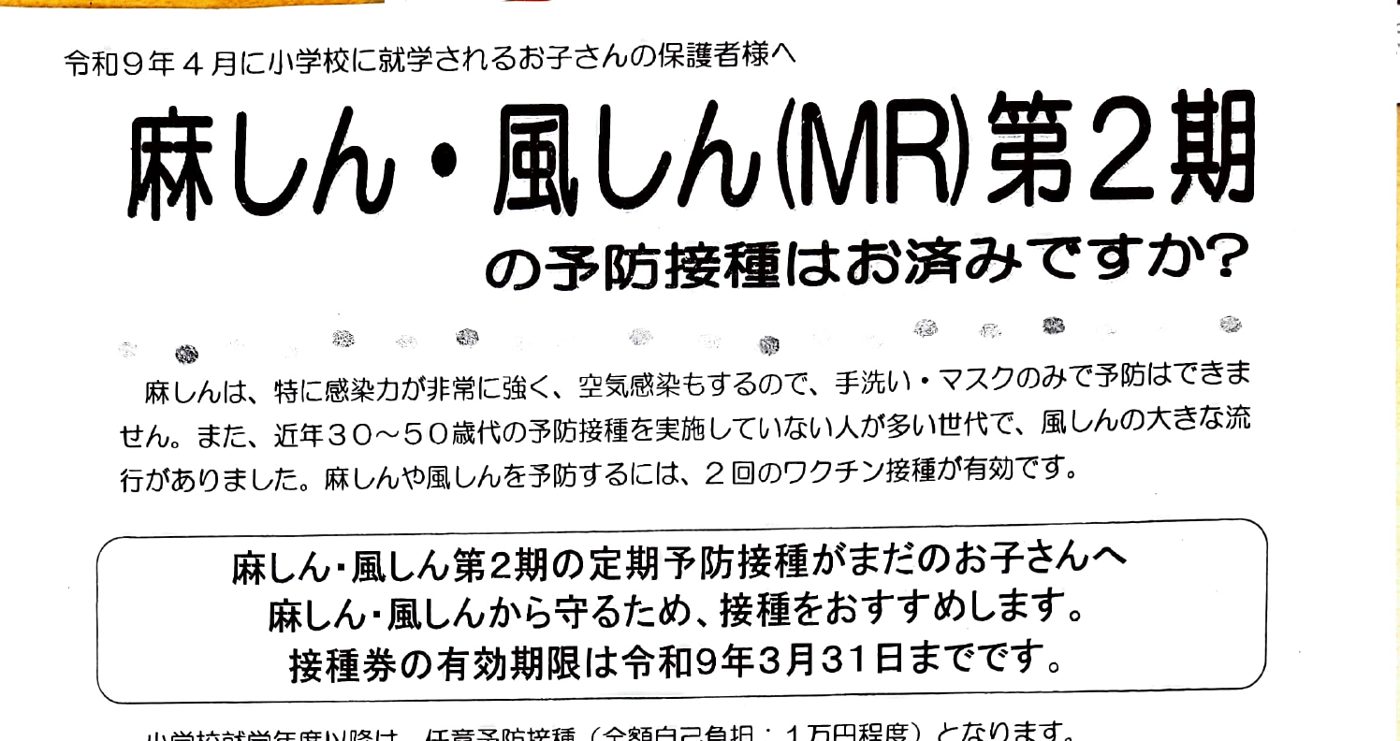
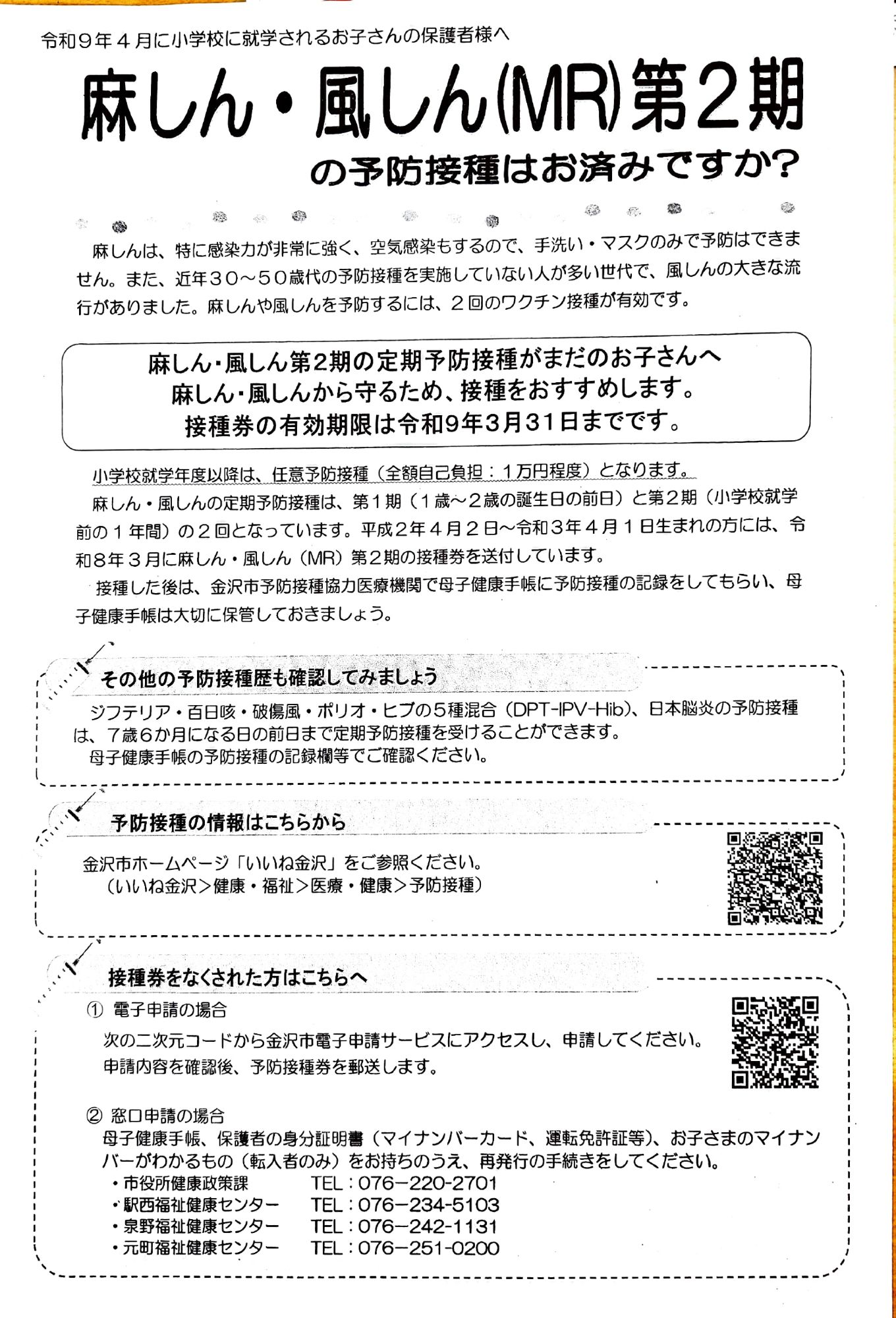
麻しん・風しん(MR)第2期の予防接種はお済みですか?
In short
Fact If your child starts elementary school in April 2027 (born 2 Apr 2020 – 1 Apr 2021, the 年長 year), Kanazawa City offers a free 2nd dose of the measles–rubella (MR) vaccine. Vouchers (接種券) were posted in March 2026. Checked by a Japanese reader
The voucher is valid until Wed 31 Mar 2027 (令和9年3月31日). After that the jab becomes voluntary and self-paid, about ¥10,000. This applies whether your child goes to a public or a private school.
Note If your child was vaccinated abroad, take their overseas vaccination record to a Kanazawa clinic and ask whether this dose is still needed. If you have lost the voucher or never received one, you can request one online or at a counter.
Key facts
| Who it is for | Children starting elementary school in April 2027 (令和9年4月) |
|---|---|
| Deadline | Wed 31 Mar 2027: voucher (接種券) expires (令和9年3月31日) |
| Cost | Free with the voucher until 令和9年3月31日 (31 Mar 2027). After that it becomes voluntary (任意予防接種) and self-paid, about ¥10,000 |
| Where | A Kanazawa City cooperating clinic (金沢市予防接種協力医療機関) |
| What to bring | Voucher (接種券) and the Maternal and Child Health Handbook (母子健康手帳), which the clinic stamps. Note if your child was vaccinated abroad, bring the overseas record too |
| Lost voucher: online | Kanazawa e-application (QR code): Reissue request form |
| Lost voucher: in person | Bring the 母子健康手帳, a parent's ID (マイナンバーカード, driving licence, etc.) and, only if you moved to Kanazawa from elsewhere (転入者のみ), something showing the child's My Number |
| Counters | 市役所健康政策課 (City Hall Health Policy Div.) 076-220-2701 駅西福祉健康センター 076-234-5103 泉野福祉健康センター 076-242-1131 元町福祉健康センター 076-251-0200 |
| Info | Kanazawa City website "いいね金沢": 予防接種 (vaccinations) page |
Action checklist
- Check your child's record (母子健康手帳 or overseas record) for two MR/MMR doses
Who: Parent · When: Soon - If the dose is needed: find the voucher, or request a reissue online or at a counter
Who: Parent · When: Well before Wed 31 Mar 2027 - Book the jab at a Kanazawa cooperating clinic; take the voucher and the record book
Who: Parent, with child · When: By Wed 31 Mar 2027 - Also check the 5-in-1 and Japanese encephalitis doses (free until the day before age 7½)
Who: Parent · When: At the same clinic visit
Full English interpretation
To parents of children starting elementary school in April 2027 (令和9年4月に小学校に就学されるお子さんの保護者様へ)
Has your child had the 2nd-period (第2期) measles–rubella (MR) vaccination?
Measles (麻しん) is extremely infectious and also spreads through the air, so handwashing and masks alone cannot prevent it. In recent years there was a large rubella (風しん) outbreak among people in their 30s to 50s, a generation in which many were never vaccinated. Two doses of vaccine are effective in preventing measles and rubella.
From the school year the child enters elementary school, it becomes a voluntary vaccination (任意予防接種), self-paid at about ¥10,000.
The routine MR vaccination has two doses: period 1 (from age 1 to the day before the 2nd birthday) and period 2 (the one year before starting elementary school). Children born 2 Apr 2020 – 1 Apr 2021 (the April 2027 school entrants, i.e. the 年長 year) were sent vouchers for the MR 2nd period in March 2026 (令和8年3月).
Note: the leaflet misprints the start of this range as 平成2年 (1990); it should read 令和2年 (2020). Checked by a Japanese reader
After the vaccination, have the Kanazawa cooperating clinic (金沢市予防接種協力医療機関) record it in the Maternal and Child Health Handbook (母子健康手帳). Keep the handbook safe.
Also check other vaccinations (その他の予防接種歴も確認してみましょう)
The 5-in-1 vaccine (diphtheria, whooping cough, tetanus, polio, Hib: DPT-IPV-Hib) and Japanese encephalitis (日本脳炎) can be given as routine vaccinations up to the day before the child turns 7 years 6 months. Please check the vaccination record pages of the 母子健康手帳.
Vaccination information (予防接種の情報はこちらから)
See the Kanazawa City website "いいね金沢" (いいね金沢 > 健康・福祉 > 医療・健康 > 予防接種). [QR code]
If you have lost the voucher (接種券をなくされた方はこちらへ)
① Online (電子申請): use the QR code to reach the Kanazawa e-application service and apply. Once the application has been checked, the voucher is posted to you.
② At a counter (窓口申請): bring the 母子健康手帳, a parent's ID (マイナンバーカード, driving licence, etc.) and something showing the child's My Number (only for people who moved to Kanazawa from elsewhere, 転入者のみ). The voucher is reissued at: City Hall Health Policy Division (市役所健康政策課), Ekinishi, Izumino or Motomachi Welfare & Health Centres (phone numbers in the table).
Images
Original pages (tap to open full size):
Changing the designated school
Only if you want a different public school
金沢市の指定校変更制度について / 指定校変更許可基準
In short
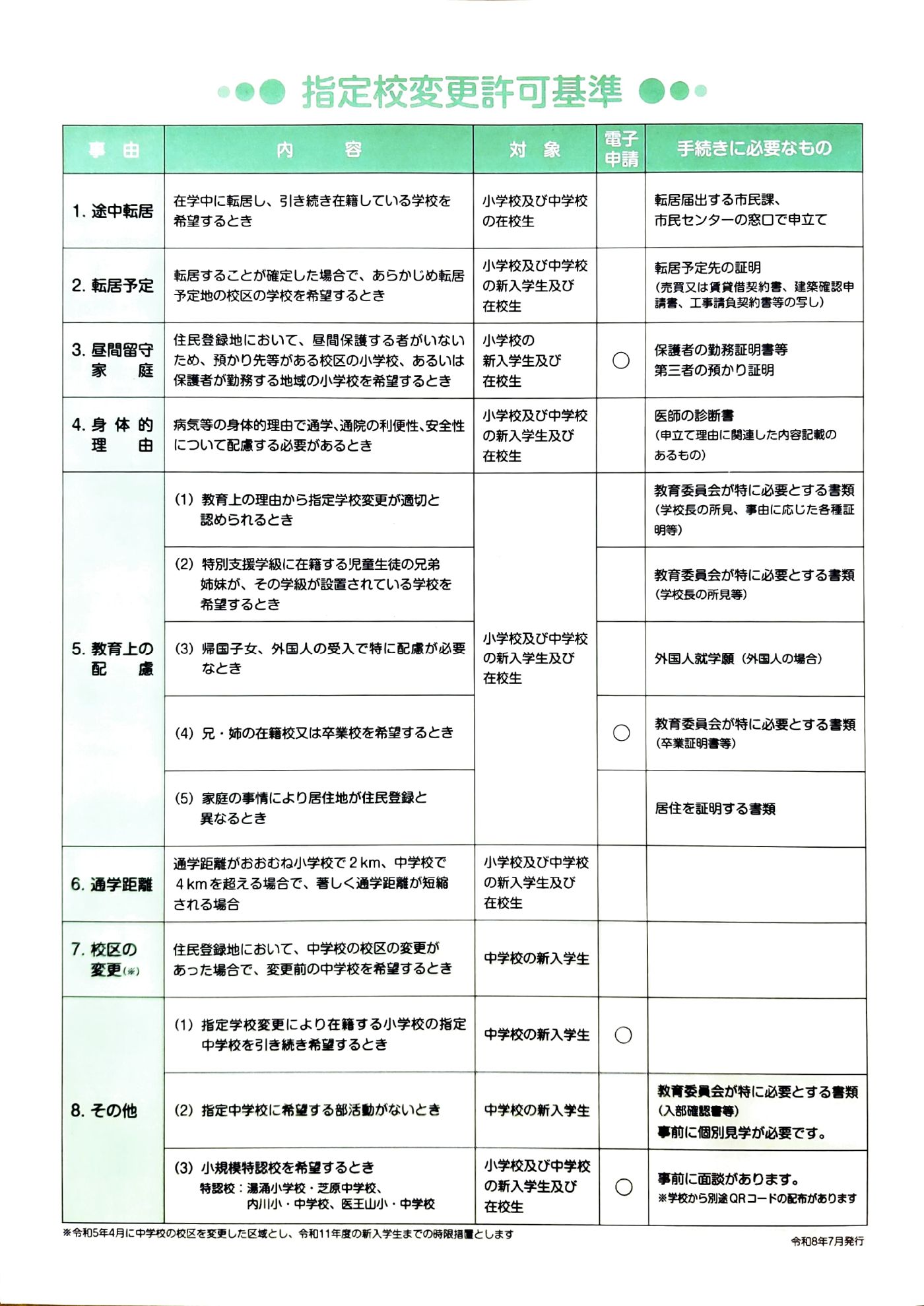
Fact Kanazawa assigns each child a city school based on the registered address (住民登録). This leaflet explains when you can apply for a different city school, for example after moving house, when nobody is home in the daytime, for medical reasons, or to join an older sibling. Some reasons can be applied for online.
If you're happy with the designated school, there's nothing to do. The 外国人就学願 in the table belongs only to row 5(3), a school-change request where a returnee or foreign child needs special consideration. It is not part of normal enrolment at the designated school. Checked by a Japanese reader
Note Foreign nationals aren't automatically enrolled in compulsory school. If your child is a foreign national going to a public school, confirm the enrolment steps with the city's 学校指導課 (the procedure hasn't been verified).
Private school? This system doesn't apply to private schools. Going private normally means telling the city or Board of Education that your child won't attend the designated public school. The exact form and deadline aren't on these papers and haven't been verified, so confirm with Kanazawa City 学校指導課 or your private school's admissions office.
Key facts
| What it is | A system to change the city primary or junior-high school you are assigned to (指定校変更制度) |
|---|---|
| Who decides | Kanazawa City Board of Education (教育委員会) |
| Online | Reasons marked 〇 in the table (daytime-absent households, older sibling's school, keeping the linked junior high school, small special-permit schools*) can be applied for online. Details: city page "指定校変更制度" *The paper marks 8(3) as 〇, but the city website says changes to special-permit schools cannot be made online. |
| Online form | From website School-change e-application (令和9年度) |
| In person | From website 教育総務課 (Education General Affairs Div.), 金沢市柿木畠1番1号 ↗ · 076-220-2431. Bring the 就学通知書 and any required documents |
| Deadline | None printed on the paper |
Action checklist
- Check the 就学通知書 (school notice) to see which school is designated
Who: Parent · When: Now - Only if you want a different city school: read the criteria and apply online or at 教育総務課
Who: Parent · When: Before April 2027 (no deadline printed) - Private school: ask 学校指導課 or the school what to submit to tell the city, and by when. Unverified step
Who: Parent · When: Soon, well before April 2027 - Foreign national going to a public school: confirm the enrolment steps with 学校指導課. Unverified
Who: Parent · When: Next contact with the city
Full English interpretation
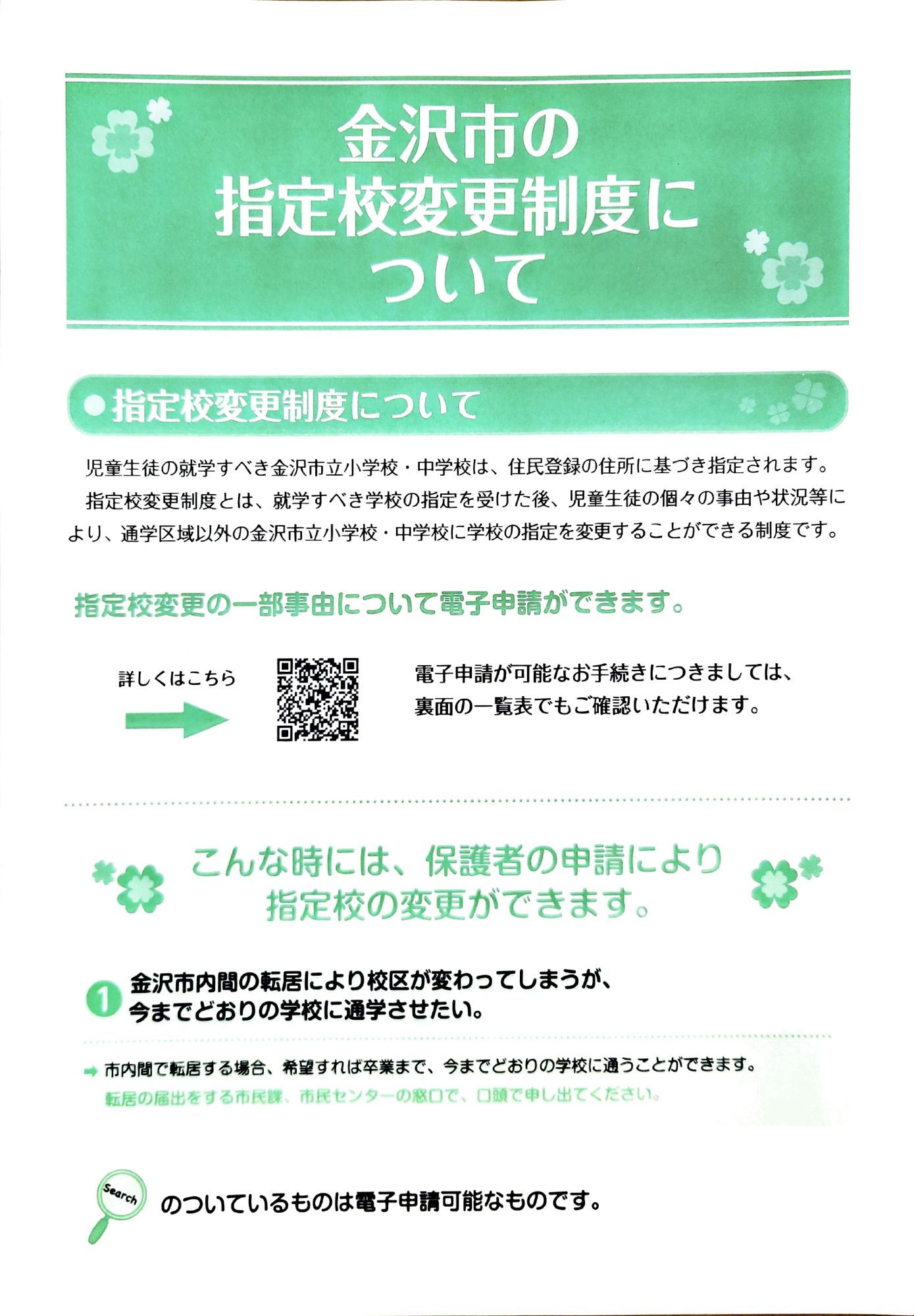
p.3 About Kanazawa's designated-school change system (金沢市の指定校変更制度について)
The Kanazawa city primary or junior-high school a child should attend is designated based on the address in their resident registration (住民登録). The designated-school change system lets you, after a school has been designated, change the designation to a Kanazawa city school outside your school zone (通学区域) because of the child's individual reasons or situation.
For some reasons you can apply online (電子申請). "For details, see here" [QR code]. The procedures that can be done online are also shown in the table on the back.
In cases like these, parents can apply to change the designated school:
① Your school zone changes because you move within Kanazawa, but you want your child to stay at their current school. If you move within the city and wish to, the child can keep attending their current school until graduation. Say so in person at the Citizens' Division (市民課) or Citizens' Centre (市民センター) counter when you report the move.
Items marked with the "Search" magnifying-glass icon can be applied for online.
p.4 Criteria for permitting a school change (指定校変更許可基準)
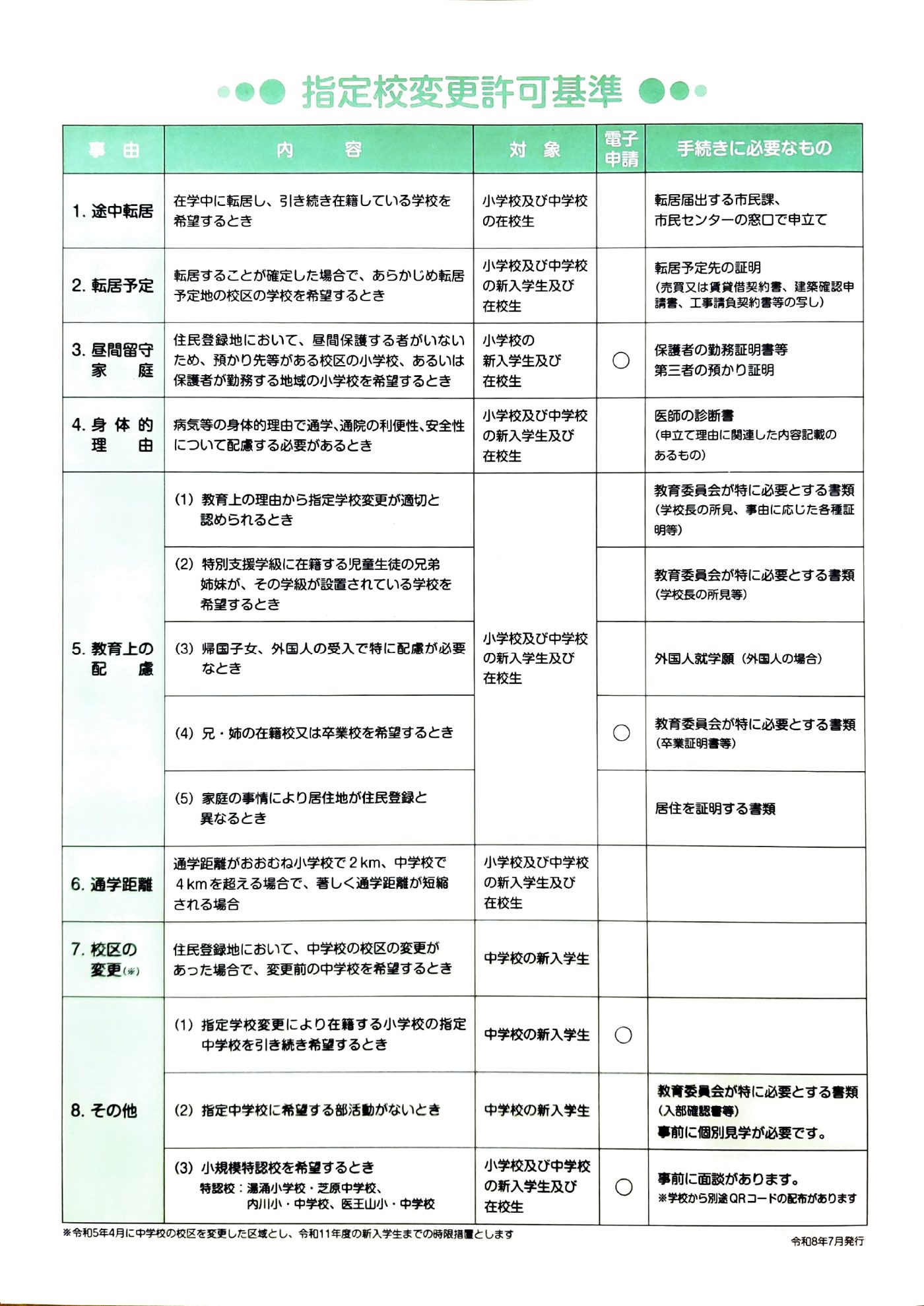
The whole table is 指定校変更許可基準 (criteria for approving a change of designated school).
| Reason | Details | Eligible | Online | Needed |
|---|---|---|---|---|
| 1. Moving during the school year (途中転居) | Moved while enrolled and want to stay at the current school | Current pupils, primary & junior high | Apply at the 市民課 / 市民センター counter when reporting the move | |
| 2. Planned move (転居予定) | A move is confirmed and you want the school of the new area in advance | New & current pupils | Proof of the new address (copy of the sale or lease contract, building confirmation application, construction contract, etc.) | |
| 3. Daytime-absent household (昼間留守家庭) | Nobody can look after the child in the daytime at the registered address, so you want the primary school where the carer is, or near the parent's workplace | New & current primary pupils | 〇 | Parent's employment certificate (勤務証明書), etc.; third party's childcare certificate (第三者の預かり証明) |
| 4. Physical reasons (身体的理由) | Illness etc. means commuting, hospital access or safety needs consideration | New & current pupils | Doctor's certificate (医師の診断書) relevant to the reason | |
| 5. Educational consideration (教育上の配慮) | (1) A change is judged appropriate for educational reasons | New & current pupils | Documents the Board requires (head teacher's opinion, relevant certificates) | |
| (2) Sibling of a child in a special-support class (特別支援学級) wants the school with that class | Documents the Board requires (head teacher's opinion, etc.) | |||
| (3) Returnee children or foreign children needing special consideration (帰国子女、外国人の受入で特に配慮が必要なとき) | 外国人就学願 (application for school enrolment, for foreign nationals) | |||
| (4) Want the school an older brother or sister attends or graduated from | 〇 | Documents the Board requires (graduation certificate, etc.) | ||
| (5) Family circumstances mean you actually live somewhere other than your registered address | Proof of residence | |||
| 6. Distance (通学距離) | The route is over about 2 km (primary) or 4 km (junior high) and would become much shorter | New & current pupils | ||
| 7. School-zone change* (校区の変更) | The junior-high zone for your registered address changed, and you want the previous junior high | New junior-high pupils | ||
| 8. Other (その他) | (1) Want to stay with the junior high linked to the primary school you attend through a school change | New junior-high pupils | 〇 | |
| (2) The designated junior high has no club activity (部活動) the child wants | New junior-high pupils | Documents the Board requires (club-entry confirmation). A visit beforehand is required | ||
| (3) Want a small special-permit school (小規模特認校): 湯涌小学校, 芝原中学校, 内川小・中学校, 医王山小・中学校 | New & current pupils | 〇 | Interview beforehand. ※A separate QR code is handed out by the school |
Note on 外国人就学願: it appears only in row 5(3), for a school-change request where a returnee or foreign child needs special consideration. It is not part of normal enrolment at the designated school. Checked by a Japanese reader
Hedged note: foreign nationals aren't automatically enrolled in compulsory school, so if your child is a foreign national going to a public school, confirm the enrolment steps with the city's 学校指導課. Kanazawa's specific procedure has not been verified.
*Only for areas whose junior-high zone changed in April 2023 (令和5年4月). A time-limited measure up to new pupils entering in the 2029 school year (令和11年度).
Images
Original pages (tap to open full size):
After-school children's clubs (gakudō)
Only if you need after-school care
放課後児童クラブのご案内 / 金沢市の放課後児童クラブ一覧
In short
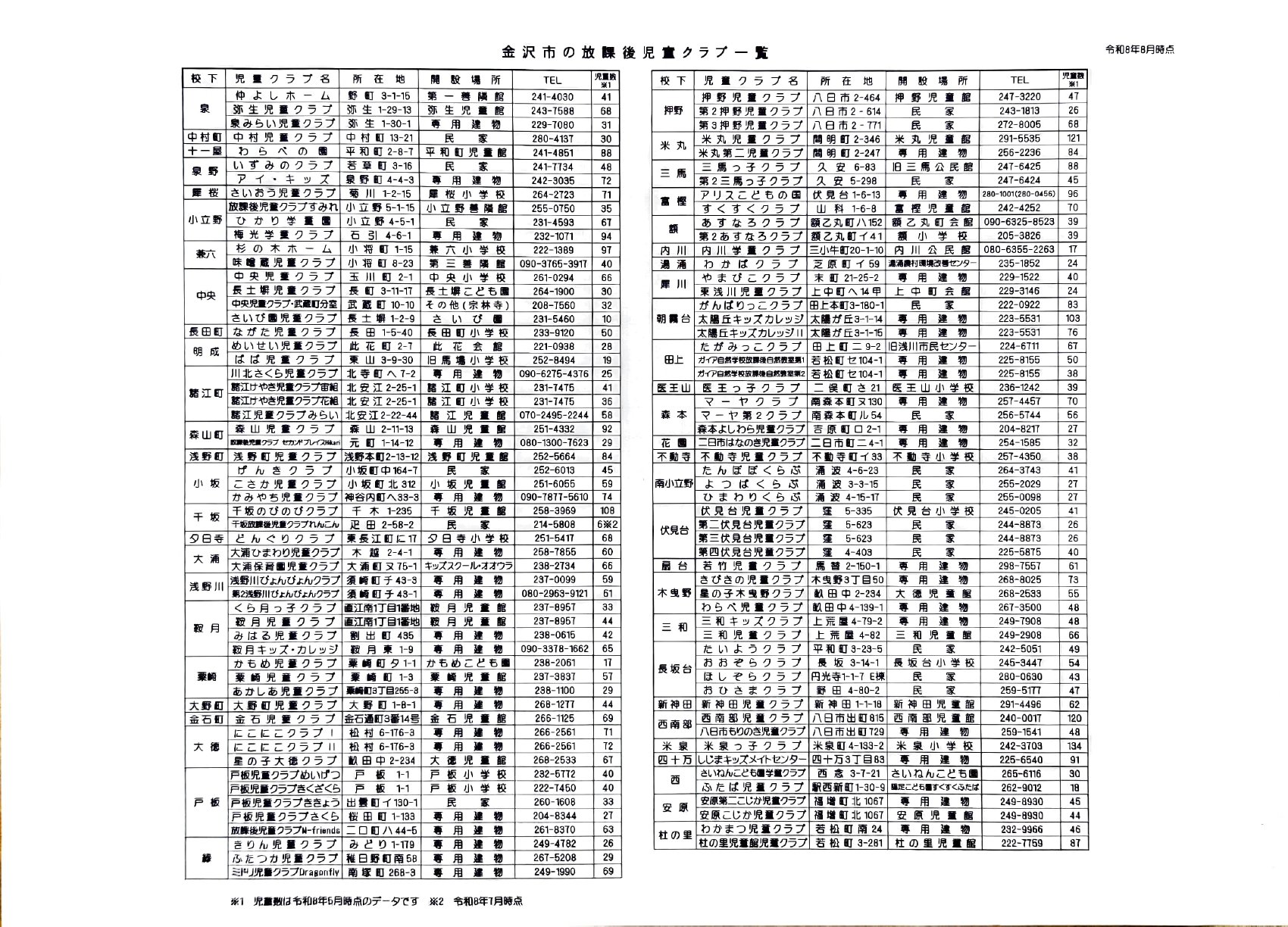
Fact Kanazawa's after-school clubs (放課後児童クラブ, often called "gakudō") look after primary pupils whose parents are out in the daytime, for example at work. Each club sets its own hours, fees and application process, so you contact the club directly. The city's list (dated August 2026) covers every school district (校下) and gives each club's address, venue, phone number and number of children.
Note Find your school district in the list (see the full-page image) and phone the clubs there. April places may fill over the winter. This isn't stated on the paper, so ask early.
Private school? Whether city clubs accept private-school pupils hasn't been verified. Many private schools run their own after-school care, so ask your school first.
Key facts
| What | After-school care for primary pupils whose parents are out in the daytime (work, etc.) |
|---|---|
| Hours / fees / applying | Set by each club. Ask the club (各クラブまでお問い合わせください) |
| Club list | The citywide list on p.7 (令和8年8月時点) is grouped by school district (校下). Columns: club name, address (所在地), venue (専用建物 dedicated building, 民家 private house, school, community hall…), phone (Kanazawa 076 numbers) and number of children (May 2026). See the full-page image below. |
| City enquiries | 子育て支援課 (Child-rearing Support Div.), 〒920-8577 金沢市広坂1丁目1番1号 (City Hall) ↗ TEL 076-220-2285 · FAX 076-220-2360 · kosodate@city.kanazawa.lg.jp |
| Deadline | None printed |
Action checklist
- Decide whether your child needs after-school care from April 2027
Who: Parent · When: Soon - Find your school district (校下) in the p.7 list and phone the clubs about hours, fees, how to apply and deadlines
Who: Parent · When: Soon. Places may fill over the winter - Private school: ask the school about its own after-school care, and ask any city club whether it accepts private-school pupils. Unverified
Who: Parent · When: Soon
Full English interpretation
p.6 Guide to after-school children's clubs (放課後児童クラブのご案内)
What is an after-school children's club? Clubs look after primary-school children from families where the parents are not at home in the daytime because of work, etc. Some clubs also plan various events, and children can make friends across school years and develop social skills. As part of its programme for children's healthy development, Kanazawa City has the clubs run by social welfare councils (社会福祉協議会), children's centres (児童館), social welfare corporations and others, with the understanding and cooperation of local people and in ways suited to each area.
About Kanazawa's after-school clubs: a list of Kanazawa's after-school clubs is printed on the back (p.7); please refer to it. Separately from the listed clubs, some facilities provide childcare along with things like cram schools (学習塾) without registering with the city. When using these, please check each operator's website, etc.
Opening hours, fees and applications are decided by each club. For details, please contact each club.
Enquiries about after-school clubs: Kanazawa City Children's Future Bureau, Child-rearing Support Division (contact details in the table).
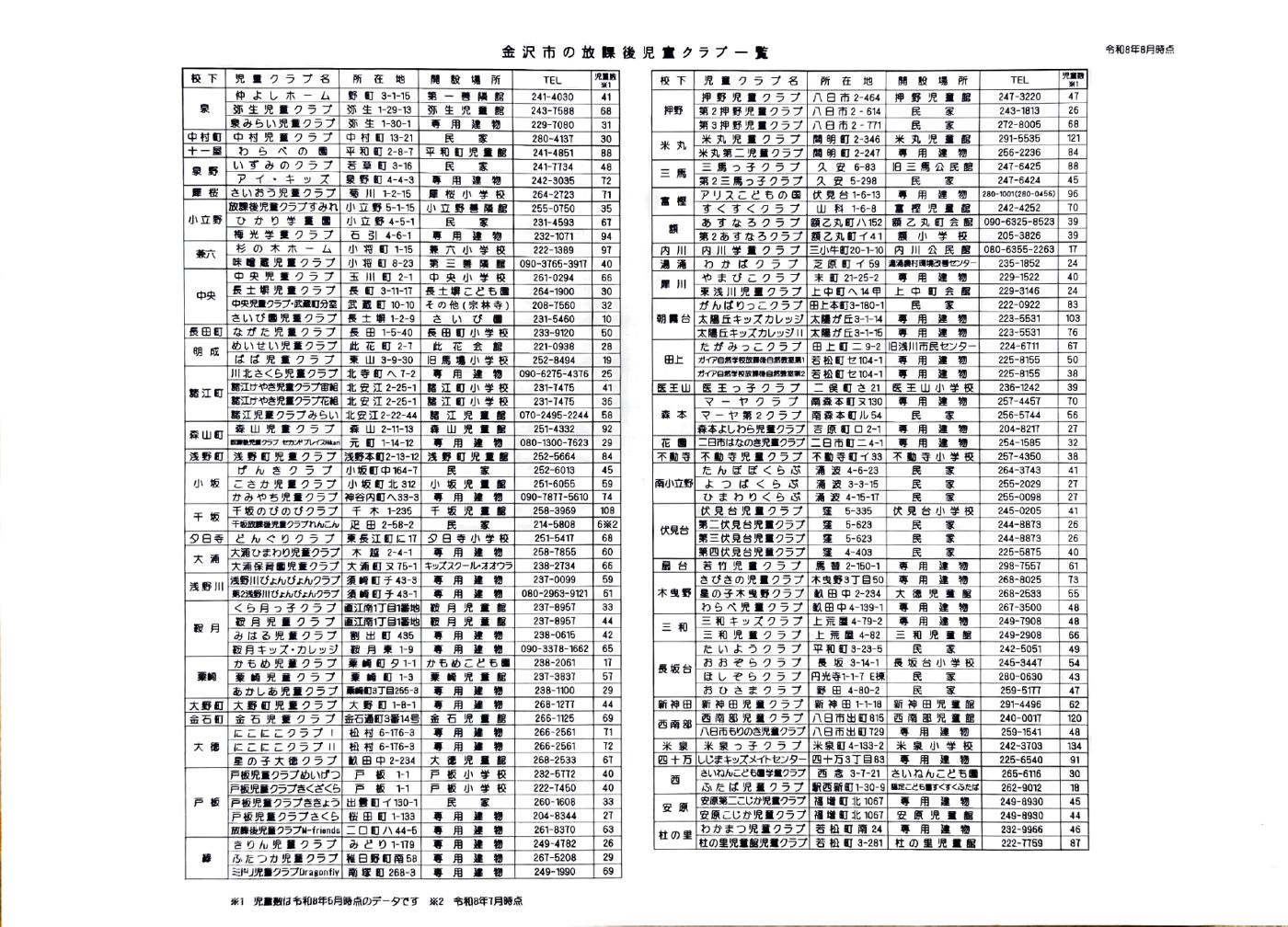
p.7 List of Kanazawa after-school clubs (金沢市の放課後児童クラブ一覧)
A citywide table with columns: school district (校下), club name, address (所在地), venue (開設場所: dedicated building 専用建物, private house 民家, school, community hall, etc.), phone and number of children. The full list is in the page image below. The 令和8年8月時点 at the top right dates the whole list (August 2026). Footnotes: ※1 means the 児童数 (number of children) column is May 2026 data. ※2 applies only to the count "6※2" for 千坂放課後児童クラブれんこん, which is as of July 2026, probably because it's a new club. Checked by a Japanese reader
Images
Original pages (tap to open full size):
Indoor school shoes (uwabaki)
Only if attending the designated public school
内履きシューズについてのお知らせ
In short
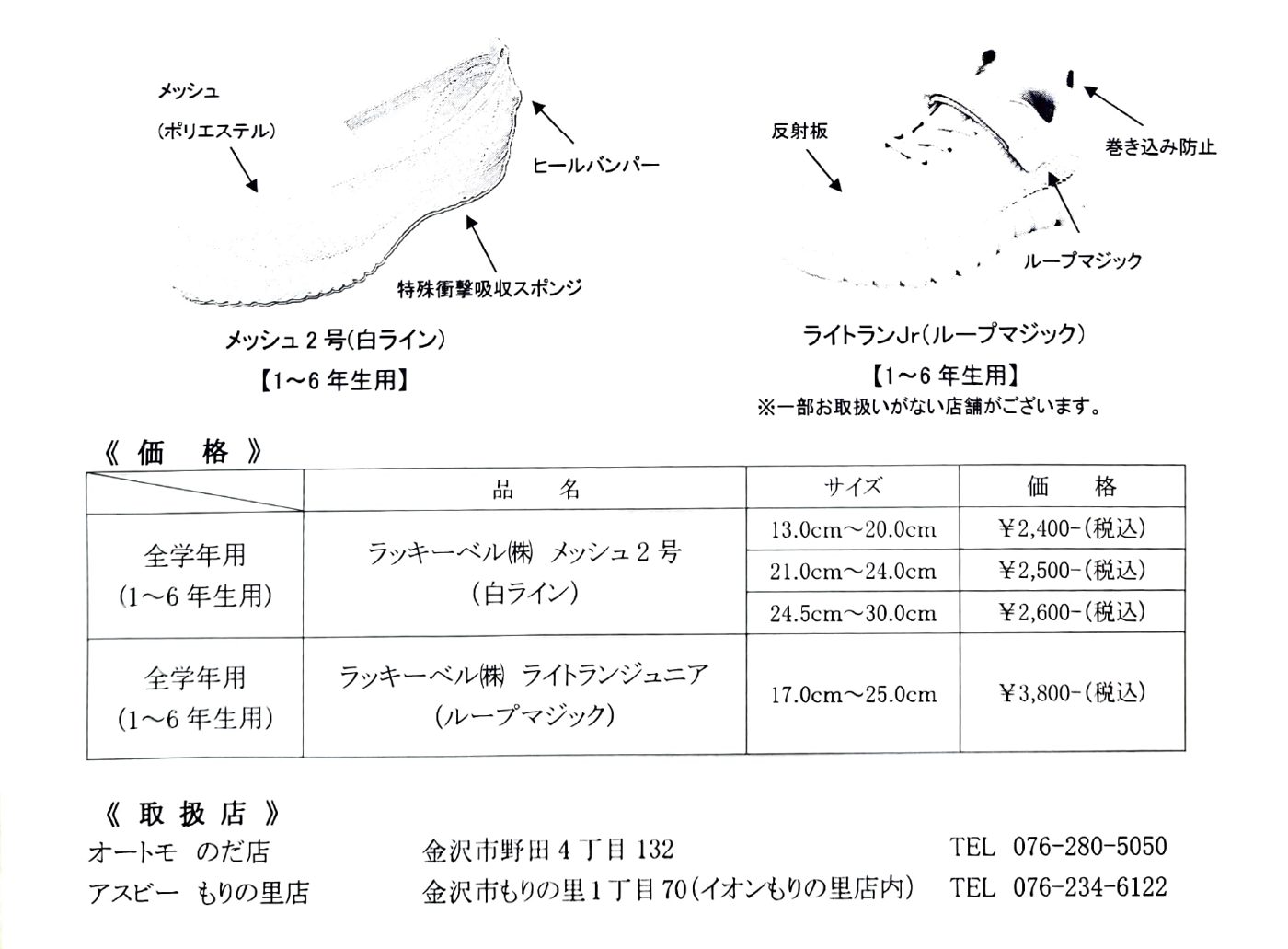
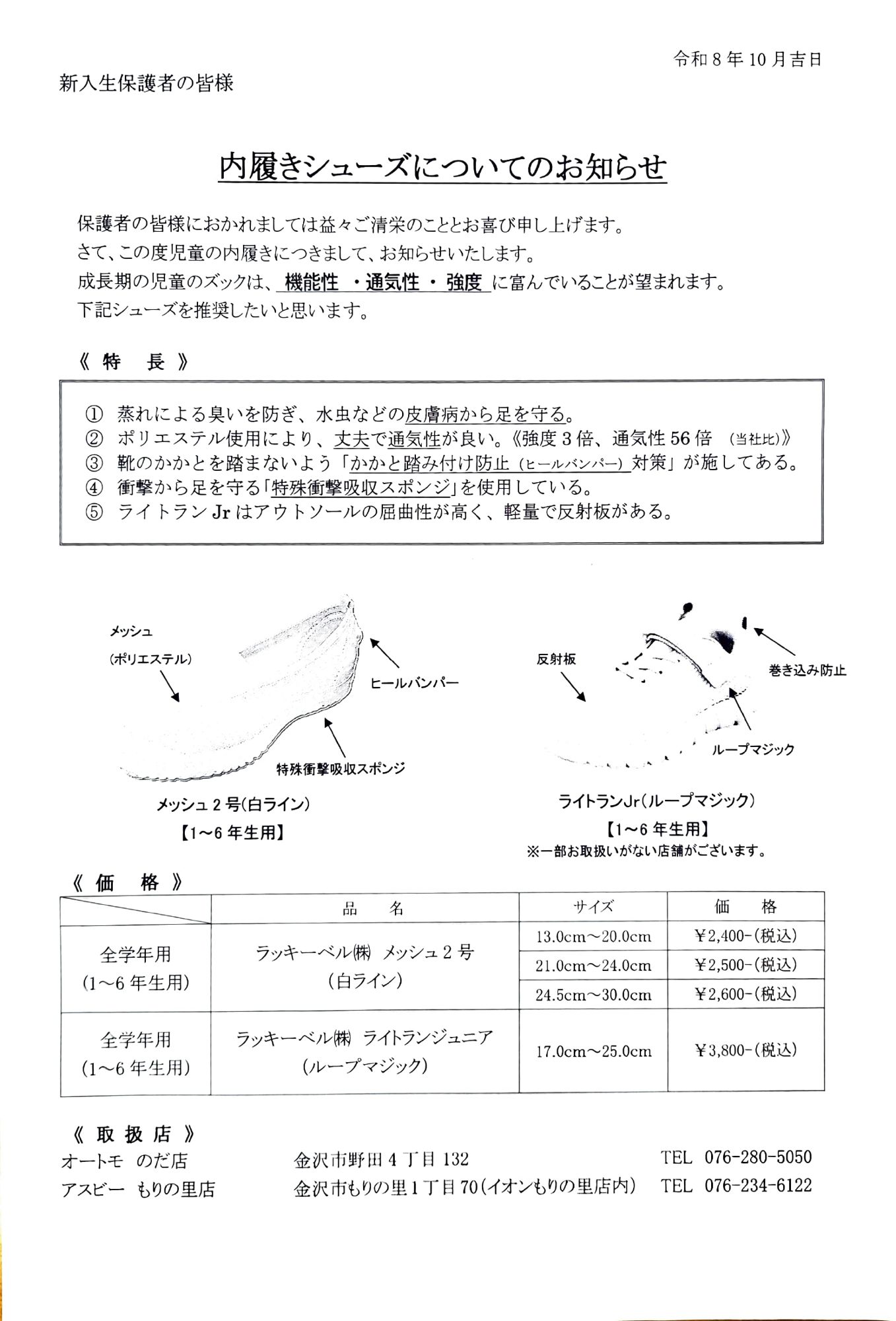
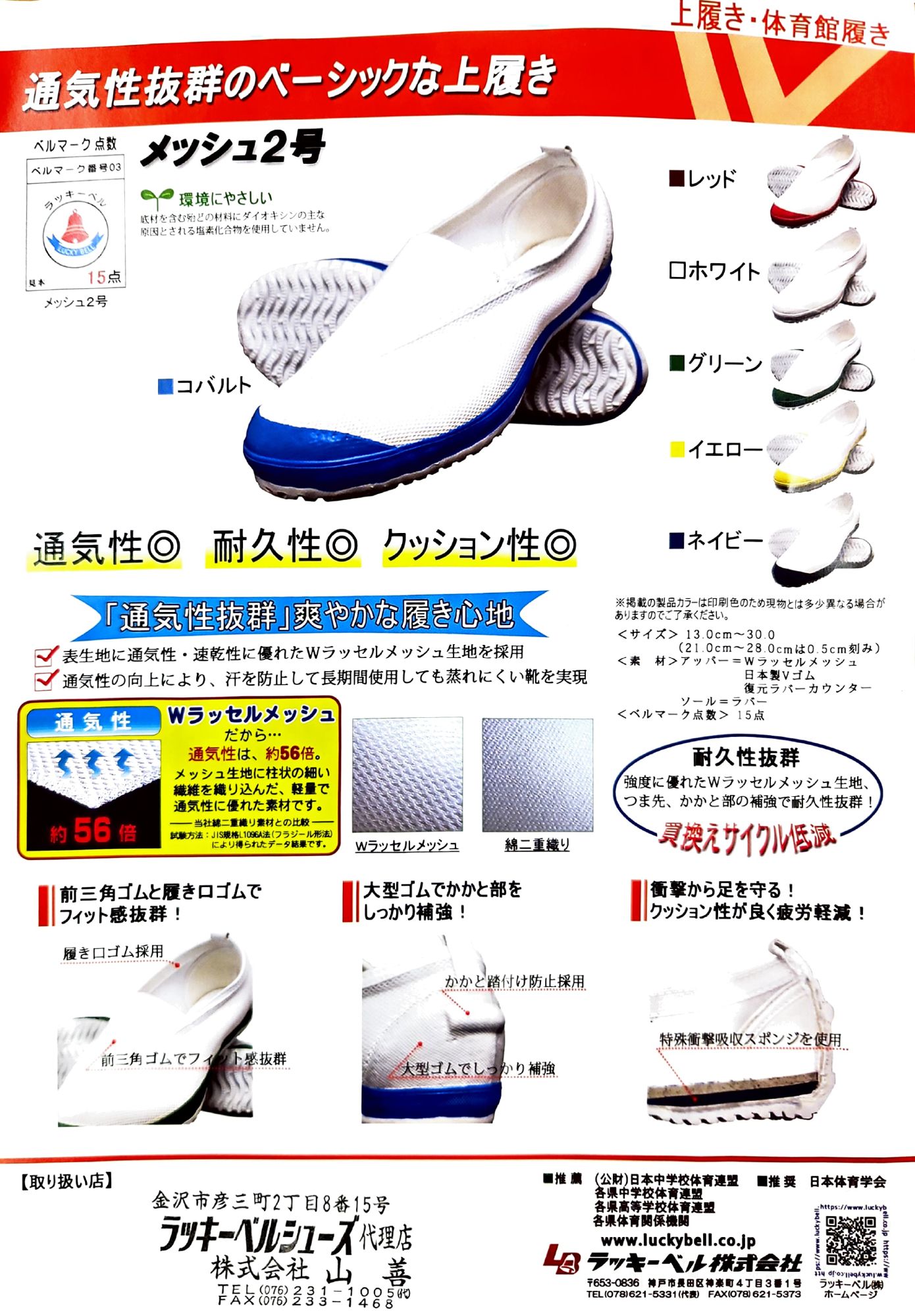
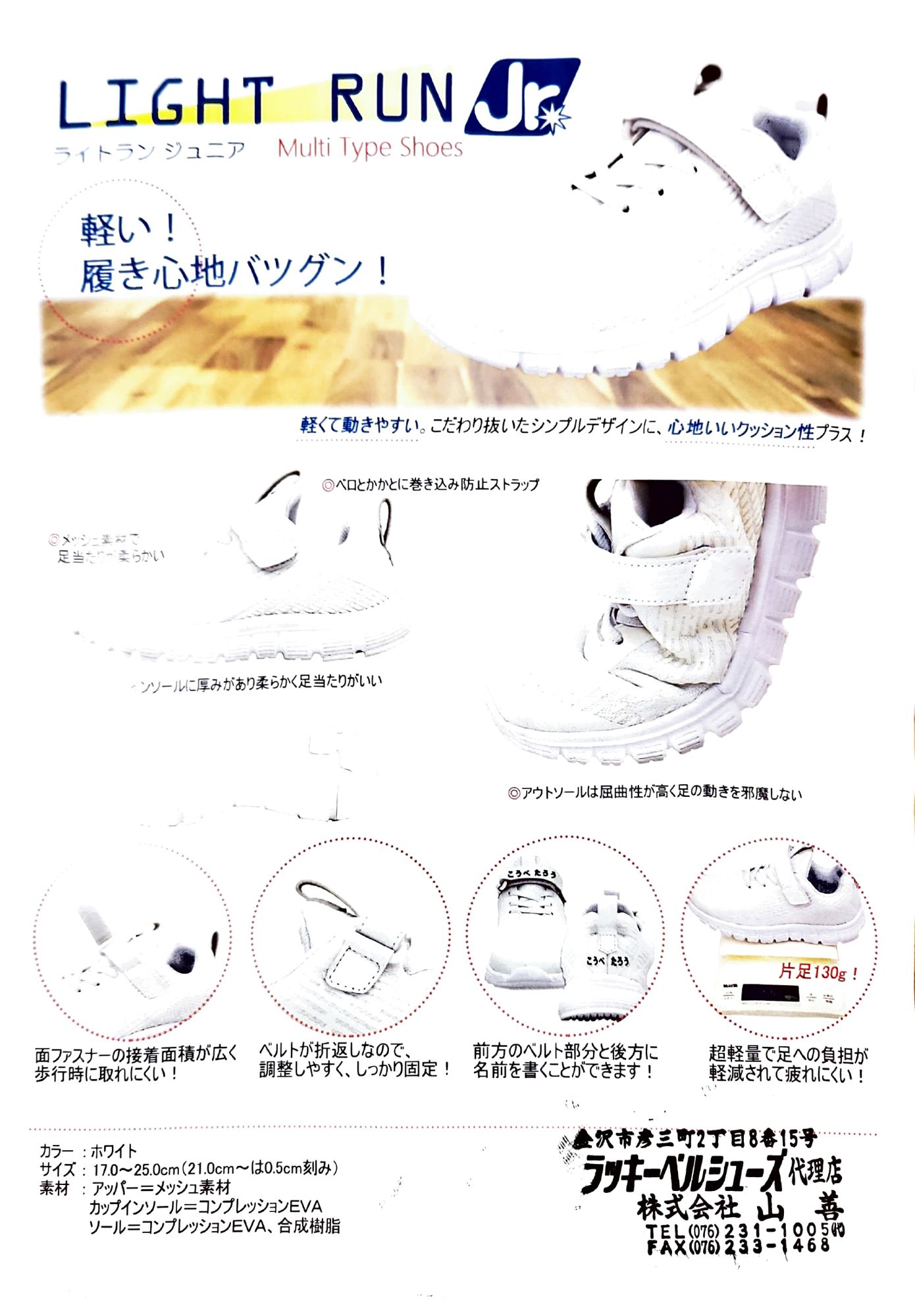
Fact This letter is dated 令和8年10月吉日 and addressed to new-entrant parents, with no sender printed. It came with the school pack and recommends two Lucky Bell indoor-shoe models: "Mesh No.2" with white line (¥2,400–2,600) or "Light Run Jr" with velcro (¥3,800).
推奨したいと思います means "we would like to recommend": both the model and the 白ライン colour are a recommendation, not a requirement. The stockists are オートモ のだ店 and アスビー もりの里店. Checked by a Japanese reader
Private school? This pack appears to follow the designated public-school route. Private schools normally set their own rules on indoor shoes, so follow your school's list.
Key facts
| For | New pupils, grades 1–6 (全学年用) |
|---|---|
| Option 1 | Lucky Bell メッシュ2号 (白ライン, white line): 13.0–20.0 cm ¥2,400 · 21.0–24.0 cm ¥2,500 · 24.5–30.0 cm ¥2,600 (tax incl.) |
| Option 2 | Lucky Bell ライトランジュニア (ループマジック, velcro): 17.0–25.0 cm ¥3,800 (tax incl.). ※Some shops don't stock it (一部お取扱いがない店舗がございます) |
| Shop 1 | オートモ のだ店: 金沢市野田4丁目132 ↗ · 076-280-5050 |
| Shop 2 | アスビー もりの里店 (inside イオンもりの里店): 金沢市もりの里1丁目70 ↗ · 076-234-6122 |
| Dealer on brochures | ラッキーベルシューズ代理店 株式会社山善: 金沢市彦三町2丁目8番15号 ↗ · TEL 076-231-1005 (代) · FAX 076-233-1468 |
| Maker | www.luckybell.co.jp (printed URL and QR code) |
| Deadline | None printed. Note Have them before school starts in April 2027 |
Action checklist
- Buy indoor shoes (上履き) in your child's size, allowing room to grow, and write the name on them. The recommended models are optional
Who: Parent · When: Before school starts, April 2027 - Private school: ignore this letter and follow the school's own supplies list
Who: Parent · When: When the school sends its information
Full English interpretation
p.24 Letter: Notice about indoor shoes (内履きシューズについてのお知らせ)
令和8年10月吉日 · To all parents of new pupils (新入生保護者の皆様)
We trust you are all well. We would like to tell you about children's indoor shoes. Shoes (ズック) for growing children should be rich in functionality, breathability and strength. We would like to recommend (推奨したいと思います) the shoes below.
Features (特長)
- Protect feet from skin problems (皮膚病) such as odour from sweatiness and athlete's foot (水虫).
- Made of polyester, so strong and breathable (3× the strength and 56× the breathability, compared with the maker's own products 当社比).
- A "heel-crush prevention" (かかと踏み付け防止, heel bumper ヒールバンパー) design, so the heel is not trodden down.
- A "special shock-absorbing sponge" (特殊衝撃吸収スポンジ) protects the feet from impact.
- Light Run Jr has a flexible outsole, is lightweight and has reflectors (反射板).
Diagrams: Mesh No.2 (white line) for grades 1–6: mesh (polyester), heel bumper, special shock-absorbing sponge. Light Run Jr (loop magic, i.e. velcro) for grades 1–6: reflector, anti-roll-in strap (巻き込み防止), loop magic. ※Some shops do not stock it.
Prices and shops: see the key facts table.
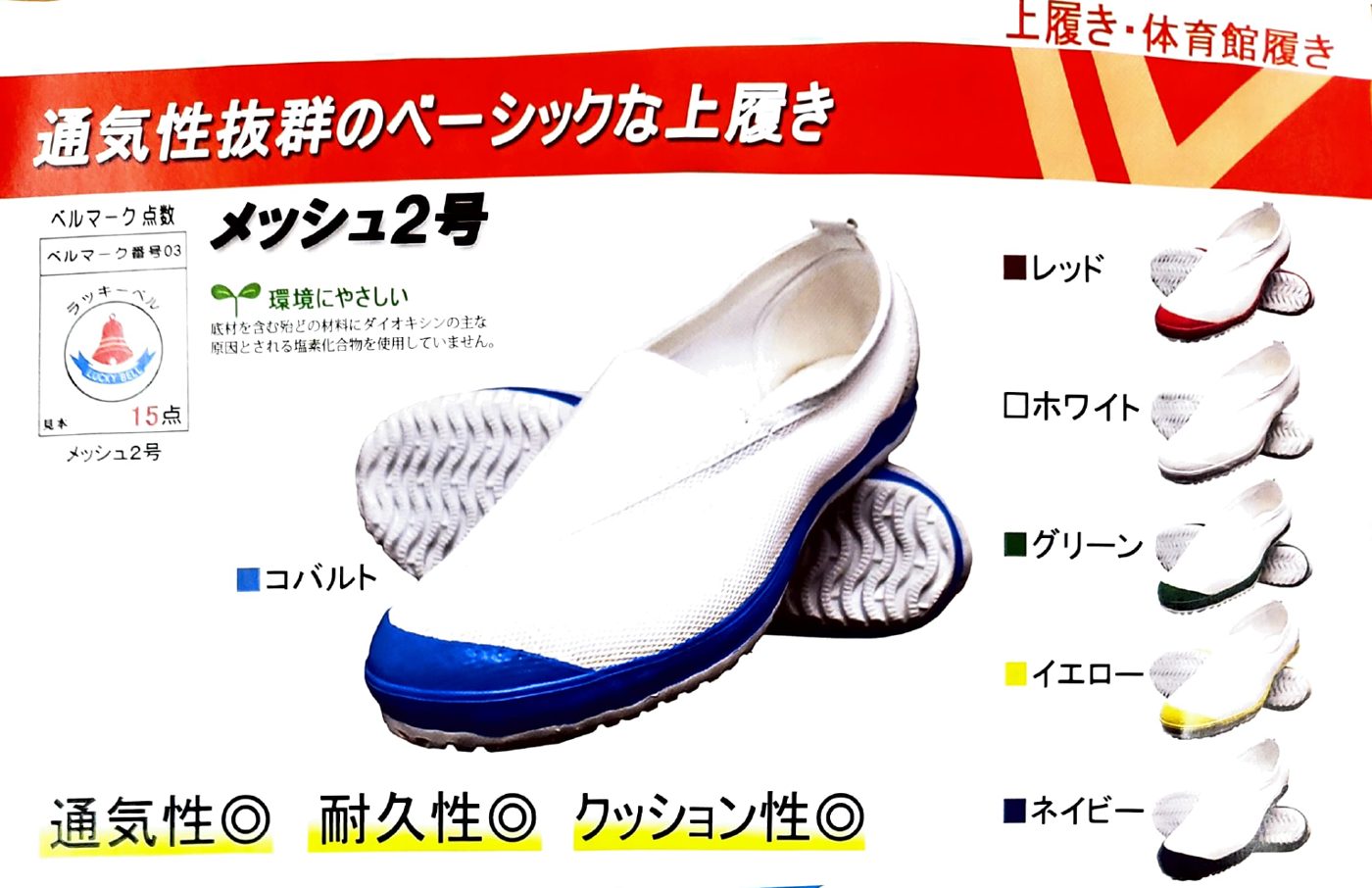
p.22 Brochure: Lucky Bell "Mesh No.2" (メッシュ2号), an "outstandingly breathable basic indoor shoe"
- Colours: red, white, green, yellow, navy, cobalt. Bell Mark points (ベルマーク): 15.
- Breathability ◎ · Durability ◎ · Cushioning ◎. The upper is a "W raschel mesh" with excellent breathability and quick drying. It prevents sweatiness, so it doesn't get stuffy even with long use. The maker says the breathability is about 56× its double-weave cotton (JIS test).
- A front triangular rubber and an elastic opening give a good fit. A large rubber piece reinforces the heel and prevents treading it down. A special shock-absorbing sponge reduces fatigue. A strong mesh, with reinforced toe and heel, means fewer replacements.
- Eco: the sole materials avoid substances that cause dioxins.
- Size 13.0–30.0 cm (0.5 cm steps for 21.0–28.0). Upper: W raschel mesh; Japan-made V rubber; recycled-rubber counter; sole: rubber.
- Recommended by: Japan Junior High School PE Federation and others (日本中学校体育連盟 etc.); endorsed by the Japanese Society of Physical Education (日本体育学会).
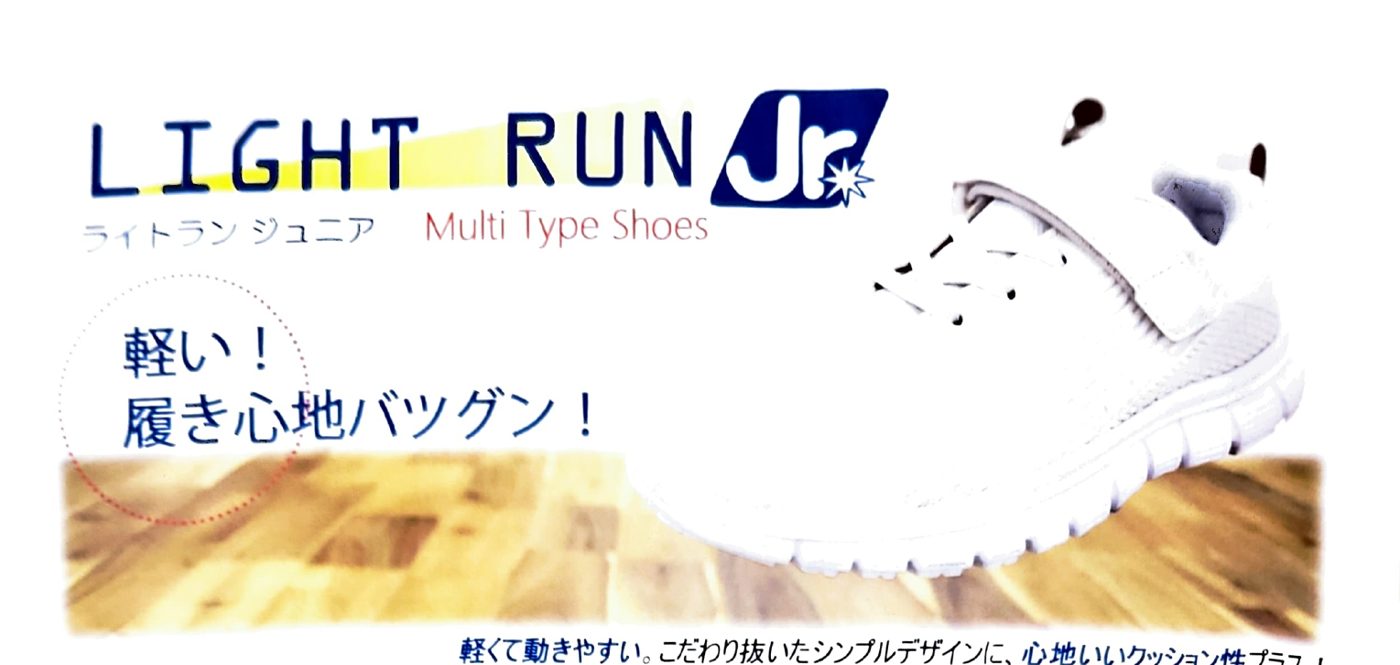
p.23 Brochure: "Light Run Jr" (ライトランジュニア), multi-type shoes
- "Light! Superb comfort!" Light and easy to move in, with a simple design plus comfortable cushioning.
- Strap that wraps the tongue and heel to prevent rolling in. The mesh is soft on the foot. A thick insole is soft and comfortable. A flexible outsole doesn't hinder foot movement.
- The velcro has a wide contact area, so it doesn't come undone while walking. The belt folds back, so it is easy to adjust and holds firmly. You can write the name on the front belt and at the back. Ultra-light, 130 g per shoe.
- Colour: white. Size 17.0–25.0 cm (0.5 cm steps from 21.0). Upper: mesh; cup insole: compression EVA; sole: compression EVA and synthetic resin.
Images
Original pages (tap to open full size):
Internet and gaming safety booklet
Information + action at phone-contract time
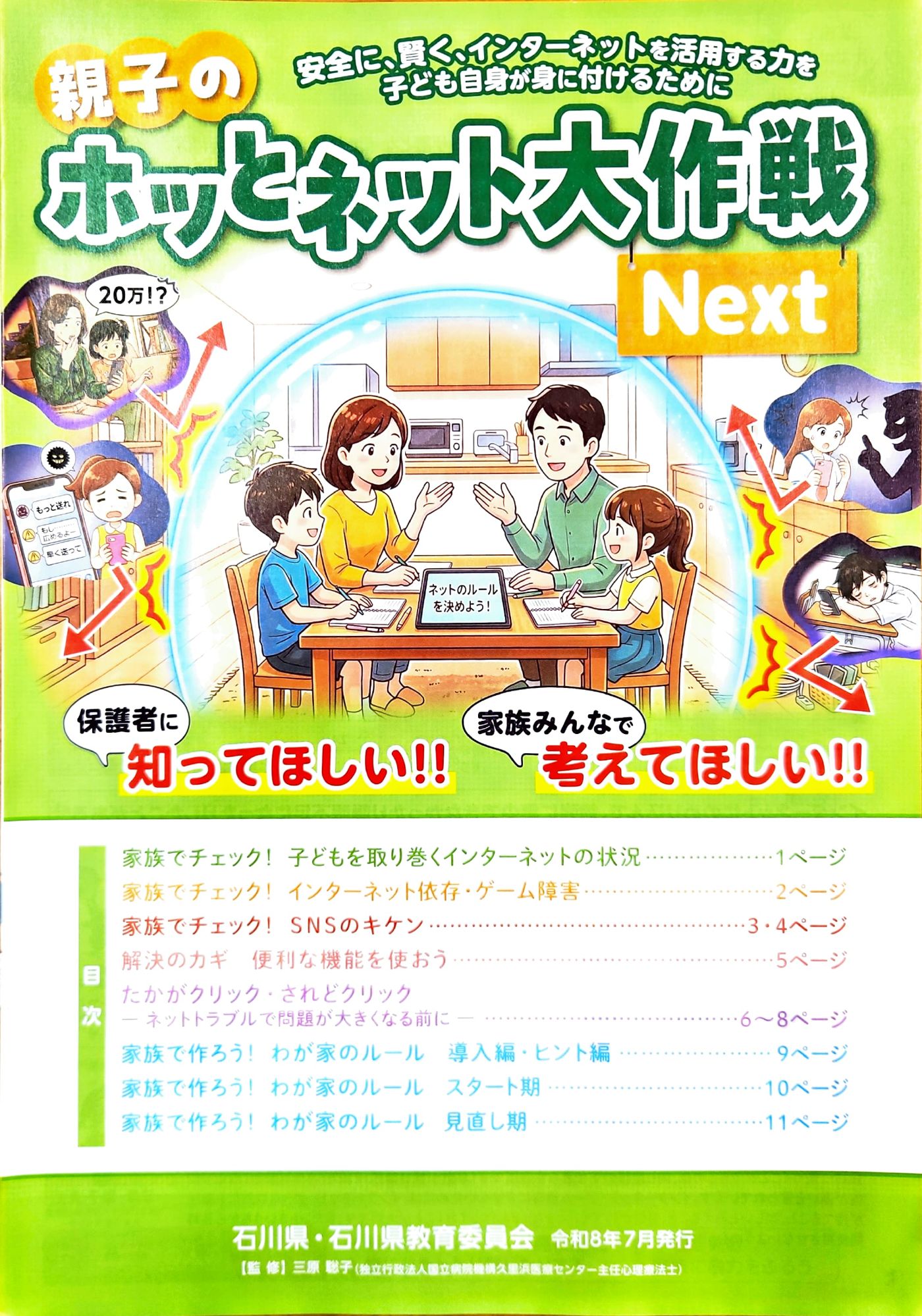
親子のホッとネット大作戦 Next
In short
Fact A 12-page Ishikawa booklet for all families. It covers children's internet use, quizzes for internet and gaming addiction, grooming and AI image abuse, online casinos, in-game spending, parental controls, a family rules sheet (scan p.18) and helplines. No deadline.
Action at phone-contract time: under 青少年インターネット環境整備法 the carrier must check the user's age, explain filtering and should set it up on the spot. If you choose not to have it, いしかわ子ども総合条例 requires you to give the carrier a written reason at contract time (not the school). Checked by a Japanese reader
For young children, the most useful steps are parental controls on any shared device (Screen Time, Digital Wellbeing / Family Link, Nintendo みまもりSwitch) and knowing the helplines (#9110 police consultation, 188 consumer hotline).
Key facts
| Parental controls | docomo · au · SoftBank · UQ mobile · Y!mobile (あんしんフィルター) |
|---|---|
| Games | Nintendo for parents · Nintendo みまもりSwitch · Sony (PlayStation) online safety · MIC video: "Are you using parental controls?" |
| More info | MIC Internet Trouble Case Studies 2026 · Ishikawa consumer trouble: working-age page · young-adult page (from the p.16 QR code) · いしかわ子ども総合条例 (ordinance) · Family-rules videos (ホッとネット大作戦 page) · げんき日記 episode, 7 Feb 2026 |
| Feedback survey | Booklet survey (optional; not submitted) |
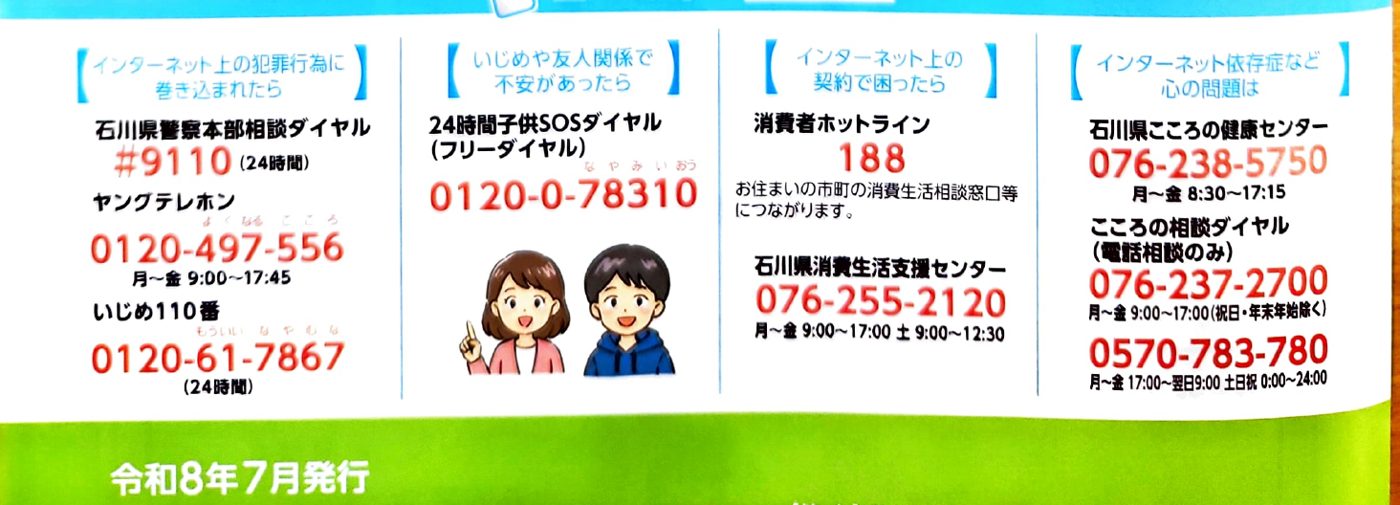
| Helplines | Police consultation #9110 (24 h) · ヤングテレホン 0120-497-556 (Mon–Fri 9:00–17:45) · いじめ110番 0120-61-7867 (24 h) · 24-hour child SOS 0120-0-78310 · Consumer hotline 188 · 石川県消費生活支援センター 076-255-2120 (Mon–Fri 9:00–17:00, Sat 9:00–12:30) · こころの健康センター 076-238-5750 (Mon–Fri 8:30–17:15) · こころの相談ダイヤル 076-237-2700 (Mon–Fri 9:00–17:00, excl. holidays & New Year) / 0570-783-780 (Mon–Fri 17:00–9:00 next day; Sat, Sun & holidays 0:00–24:00) |
| Publishers | 石川県教育委員会事務局 生涯学習課 076-225-1839 · 石川県健康福祉部少子化対策監室 076-225-1422 · 石川県生活環境部生活安全課 076-225-1386 |
Action checklist
- Turn on parental controls on any device your child uses (Screen Time, Family Link / Digital Wellbeing, Nintendo みまもりSwitch)
Who: Parent · When: When a device is introduced - Fill in the family-rules sheet (scan p.18) together and put it up
Who: Parent and child · When: When your child starts using a device - When signing a child's phone contract: have the carrier set up filtering on the spot. If you decline, you must hand the carrier a written reason (いしかわ子ども総合条例), not the school
Who: Whoever signs the contract · When: At the carrier shop - Save the helplines: #9110 (police consultation) and 188 (consumer hotline)
Who: Parent · When: Any time
Full English interpretation
The booklet is mostly charts and manga. Below is a faithful page-by-page interpretation of the text, with the chart numbers summarised.
Cover (scan p.8): "Parent and child Hot-to-Net Grand Strategy Next" (親子のホッとネット大作戦 Next)
So that children themselves gain the ability to use the internet safely and wisely. "Parents: we want you to know!! Families: we want you to think about it together!!" Contents: internet situation around children (p.1); internet addiction and gaming disorder (p.2); SNS dangers (pp.3–4); key to solutions: use handy functions (p.5); "just a click, but…": before net trouble grows (pp.6–8); making our family rules: introduction and hints (p.9), start stage (p.10), review stage (p.11).
p.1 (scan p.9): The internet situation around children
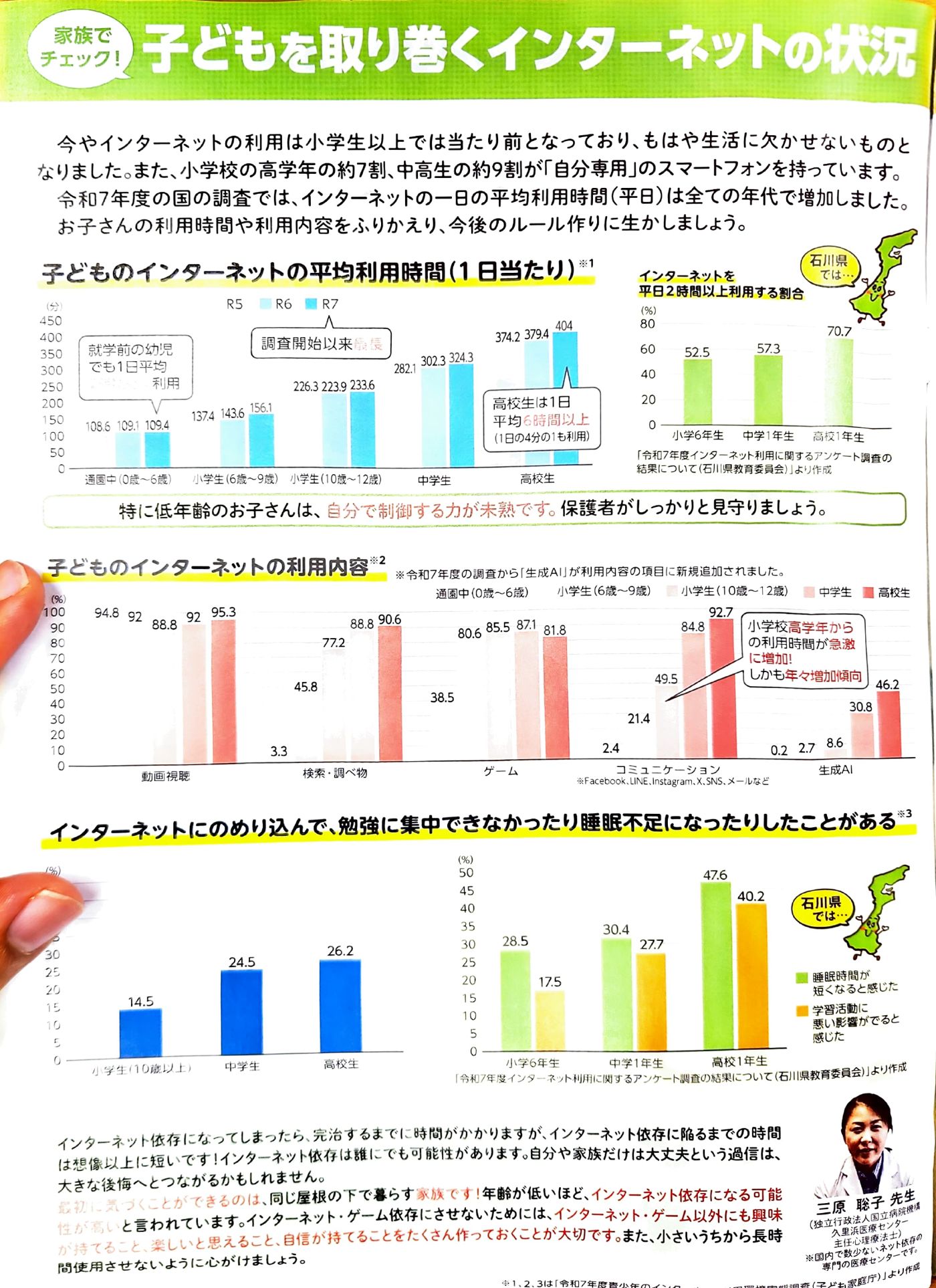
Internet use is now normal from elementary age up and has become essential to daily life. About 70% of upper-elementary pupils and about 90% of junior and senior high students have a smartphone "of their own". In the 2025 national survey, average weekday internet time rose in every age group. Look back at your child's usage time and content and use that in making future rules.
Average daily internet use, weekdays (minutes, 2023 / 2024 / 2025): preschool (0–6) 108.6 / 109.1 / 109.4 ("even preschoolers average over an hour a day"); primary 6–9: 137.4 / 143.6 / 156.1; primary 10–12: 226.3 / 223.9 / 233.6; junior high 282.1 / 302.3 / 324.3; senior high 374.2 / 379.4 / 404 ("over 6 hours, a quarter of the day"). The highest since the survey began. Ishikawa: share using the internet 2+ hours on weekdays: primary 6th grade 52.5%, junior high 1st year 57.3%, senior high 1st year 70.7%.
Young children especially have an immature ability to control themselves. Parents should watch over them carefully.
What children use the internet for: video watching is highest at every age; games, search and communication rise with age. Communication (Facebook, LINE, Instagram, X, SNS, email) rises sharply from upper elementary and increases every year. Generative AI was added as a new item in the 2025 survey.
Couldn't focus on study or lacked sleep because of being absorbed in the internet: nationally, primary (10+) 14.5%, junior high 24.5%, senior high 26.2%. Ishikawa (felt sleep was shortened / felt study was harmed): primary 6th grade 28.5 / 17.5%, junior high 1st year 30.4 / 27.7%, senior high 1st year 47.6 / 40.2%.
Dr Satoko Mihara: Once internet addiction sets in, full recovery takes time, but falling into it happens far faster than you'd think! Anyone can develop it. Overconfidence that "my family will be fine" can lead to big regret. The ones who can notice first are the family living under the same roof! It is said that the younger the child, the higher the risk. To prevent internet and gaming addiction, it's important to build up many interests outside the internet and games, things they enjoy and things that give them confidence. And from an early age, try not to let them use devices for long periods.
p.2 (scan p.10): Internet addiction and gaming disorder
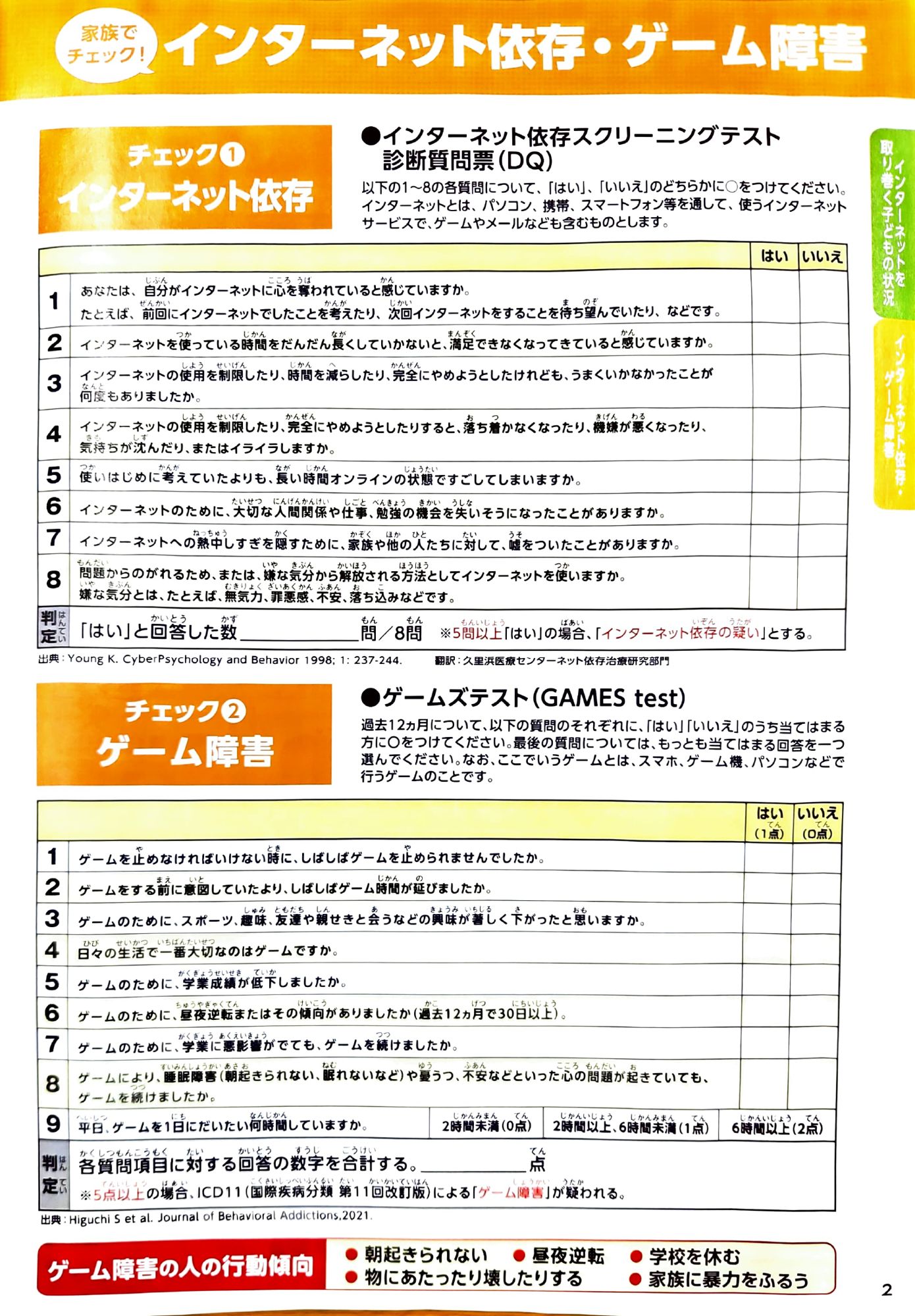
Check ① Internet addiction screening (DQ): circle yes or no for each. "Internet" means services used via PC, mobile or smartphone, including games and email.
- Do you feel preoccupied with the internet? (e.g. thinking about what you did last time online, or longing for the next time)
- Do you feel you need to use it for longer and longer to be satisfied?
- Have you repeatedly tried, and failed, to limit, cut down or stop?
- When you try to limit or stop, do you feel restless, moody, low or irritable?
- Do you stay online longer than you intended?
- Have you nearly lost an important relationship, job, study or opportunity because of the internet?
- Have you lied to family or others to hide how absorbed you are?
- Do you use the internet to escape problems or relieve bad feelings (helplessness, guilt, anxiety, depression)?
Result: 5 or more "yes" = suspected internet addiction. (Young K., CyberPsychology and Behavior 1998; translated by Kurihama Medical & Addiction Center.)
Check ② Gaming disorder (GAMES test): about the past 12 months. Yes = 1 point, no = 0 points. "Games" means games on smartphones, consoles or PCs.
- Often unable to stop playing when you had to?
- Often played longer than intended?
- Felt your interest in sport, hobbies or meeting friends dropped markedly because of games?
- Is gaming the most important thing in your daily life?
- Did your school performance fall because of games?
- Did your days and nights get reversed (昼夜逆転) because of games, or nearly so, on 30+ days in the past 12 months?
- Kept playing even though it harmed your studies?
- Kept playing despite sleep problems (can't get up, can't sleep) or mental problems (low mood, anxiety)?
- On weekdays, how long do you play? Under 2 h (0 points) · 2 h to under 6 h (1 point) · 6 h or more (2 points)
Result: 5 or more points suggests "gaming disorder" under ICD-11. (Higuchi S. et al., Journal of Behavioral Addictions, 2021.) Typical behaviour: can't get up in the morning, day–night reversal, skipping school, hitting or breaking things, violence towards family.
p.3 (scan p.11): SNS dangers (SNSのキケン)
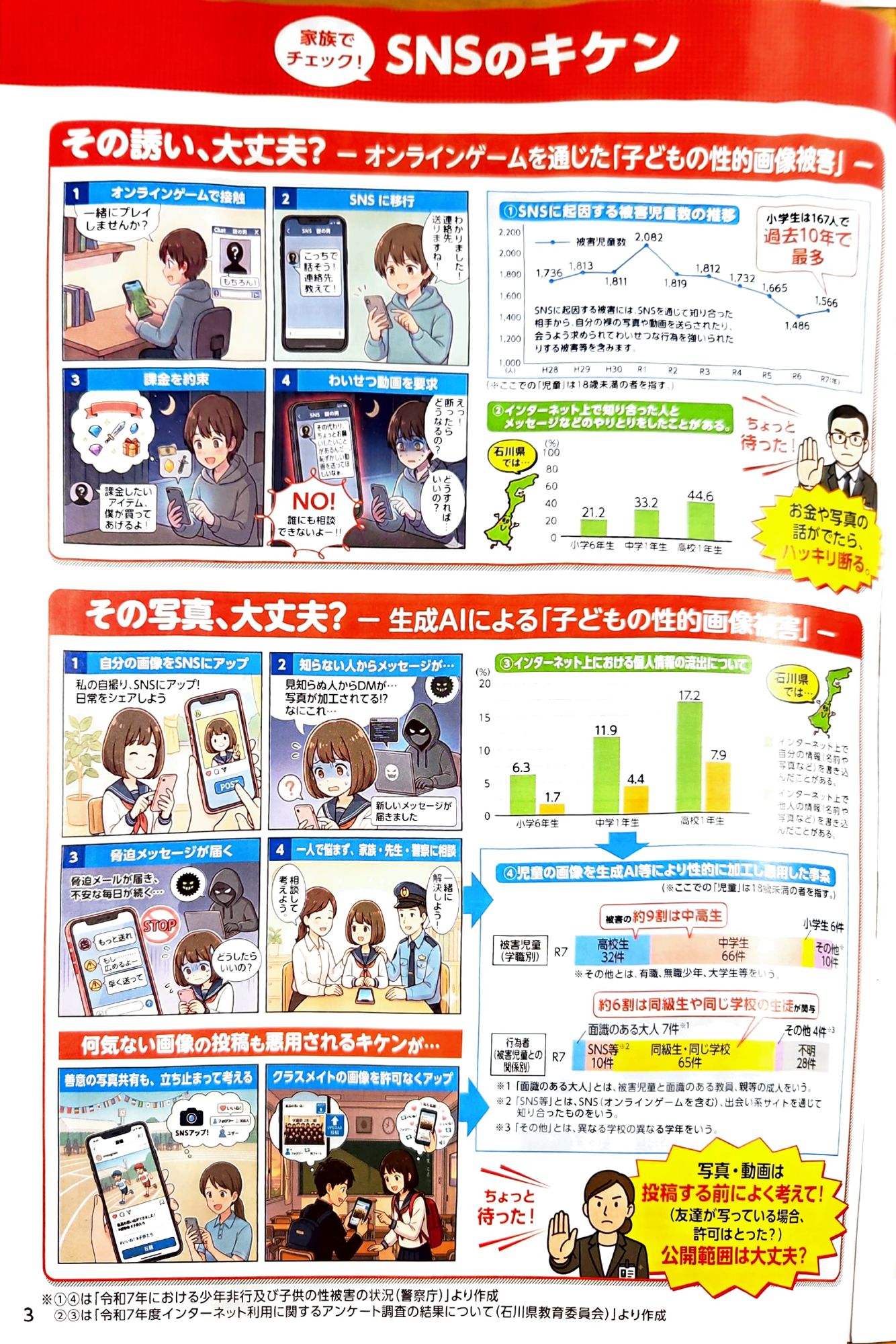
"Is that invitation safe?" Sexual-image victimisation of children through online games. Manga: 1. Contact in an online game: "Want to play together?" 2. Moving to SNS: "Let's talk here. Give me your contact." 3. Promise of in-game purchases: "I'll buy you the item you want." 4. Demand for an indecent video: "NO! I can't tell anyone…"
Chart ①: number of child victims of crime arising from SNS (under 18): 1,566 in 2025. Primary pupils: 167, the most in the past 10 years. ③ Ishikawa: has exchanged messages with someone met online: primary 6th grade 21.2%, junior high 1st year 33.2%, senior high 1st year 44.6%. "Hold on! If money or presents come up, say NO clearly."
"Is that photo safe?" Sexual-image victimisation via generative AI. Manga: 1. Uploading a selfie to SNS ("sharing my day"). 2. A DM from a stranger: "Your photo has been edited…" 3. Threatening messages arrive. 4. Don't struggle alone: talk to family, teachers or the police ("Let's solve it together!"). Chart ③: Ishikawa children who have posted personal information online (the two series' labels are too small to read; values: primary 6th 6.3 / 1.7, junior high 1st 11.9 / 4.4, senior high 1st 17.2 / 7.9). ④ Cases where children's images were sexually altered with generative AI, 2025: about 90% of victims were junior or senior high students (senior high 32, junior high 66, primary 6, other 10). About 60% involved classmates or pupils at the same school (65); acquaintance adults such as teachers or parents 7; via SNS 10; other 4; unknown 28.
Risks of posting harmless-looking images: stop and think even about posting a school-uniform photo; don't upload classmates' images without permission. "Think carefully before posting photos or videos! (If friends are in it, did you get permission?) Is your sharing range OK?"
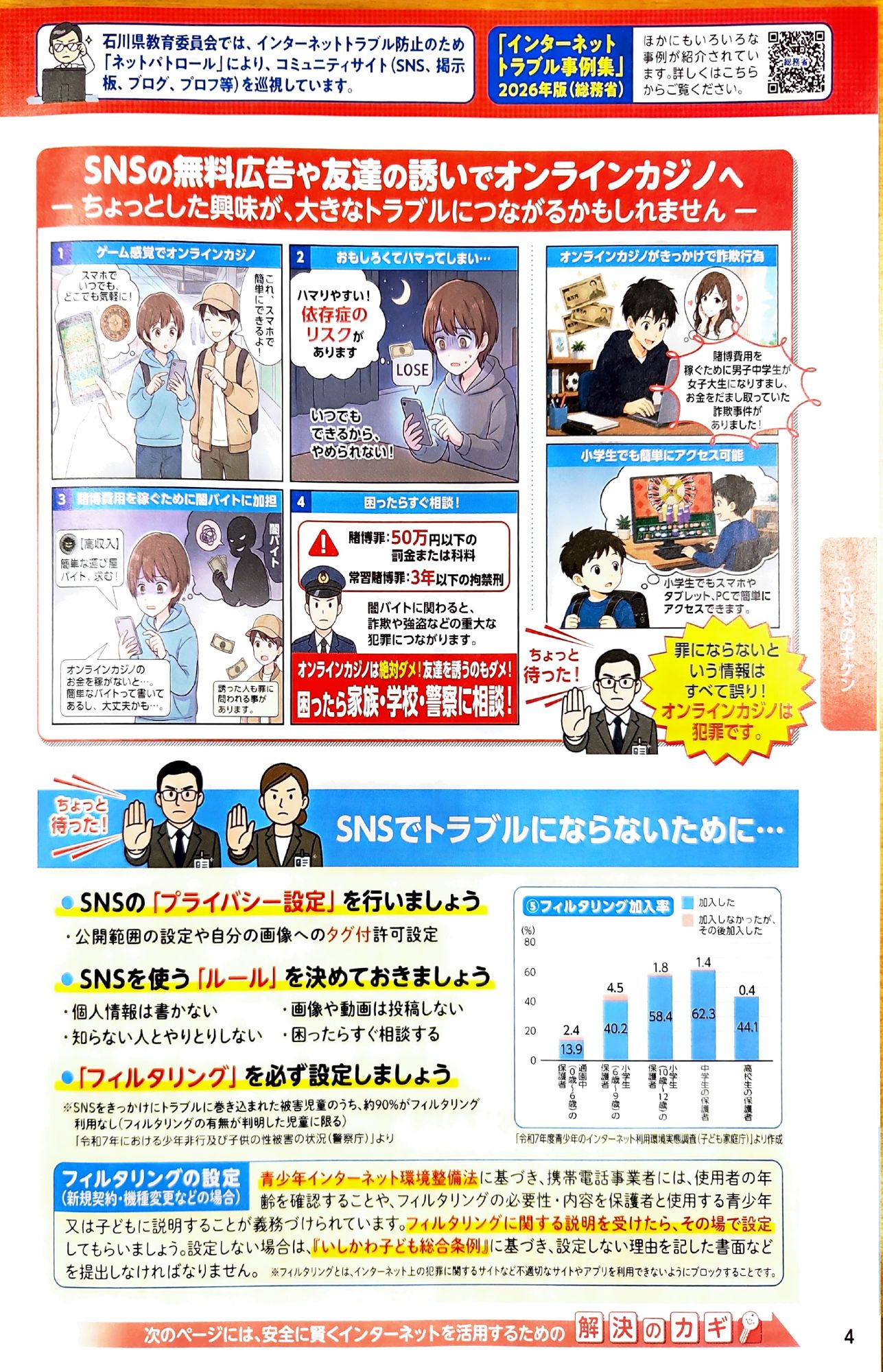
p.4 (scan p.12): Online casinos, and avoiding SNS trouble
The Ishikawa Board of Education patrols community sites (SNS, message boards, blogs, profiles) through its "Net Patrol" to prevent internet trouble. "Internet Trouble Case Studies 2026 (MIC)": many other cases are presented, so please take a look (QR code).
From free SNS ads or a friend's invitation to online casinos: a little curiosity may lead to big trouble. 1. Online casino that feels like a game ("easy on your phone, any time"). 2. Hooked on the fun; risk of addiction ("can stop any time!"). 3. Joins a "dark part-time job" (闇バイト) to earn gambling money. 4. Ask for help at once! Gambling: fine of up to ¥500,000 or a petty fine. Habitual gambling: up to 3 years' imprisonment. Getting involved in dark part-time jobs leads to serious crimes such as fraud and robbery. Online casinos are absolutely forbidden! So is inviting friends! If in trouble, talk to family, school or police! Example: a junior-high boy defrauded a female university student to get gambling money. Even primary pupils can easily access these sites on a smartphone, tablet or PC. "Information saying it isn't a crime is all wrong! Online casinos are a crime!"
To avoid trouble on SNS: set up privacy settings (who can see posts; permission for tagging your image). Decide rules for using SNS: don't write personal information; don't post images or videos; don't interact with strangers; ask for help straight away when in trouble. Always set up filtering: about 90% of children harmed through SNS were not using filtering (among those where this was known; police, 2025). Chart ⑤ filtering use: parents of preschoolers 13.9% (+2.4% added later), primary 6–9: 40.2% (+4.5), primary 10–12: 58.4% (+1.8), junior high 62.3% (+1.4), senior high 44.1% (+0.4).
Setting up filtering (new contract or phone change): under the Youth Internet Environment Act (青少年インターネット環境整備法), mobile carriers must check the user's age and explain to the parent and the young user why filtering is needed and what it does. Carriers should set it up on the spot: once you have had the explanation, have it set up there and then. If parents choose not to, the Ishikawa Children's Comprehensive Ordinance (いしかわ子ども総合条例) requires them to submit a written reason to the carrier at contract time (not to the school). Checked by a Japanese reader (Filtering blocks inappropriate sites and apps, such as those connected with crime.)
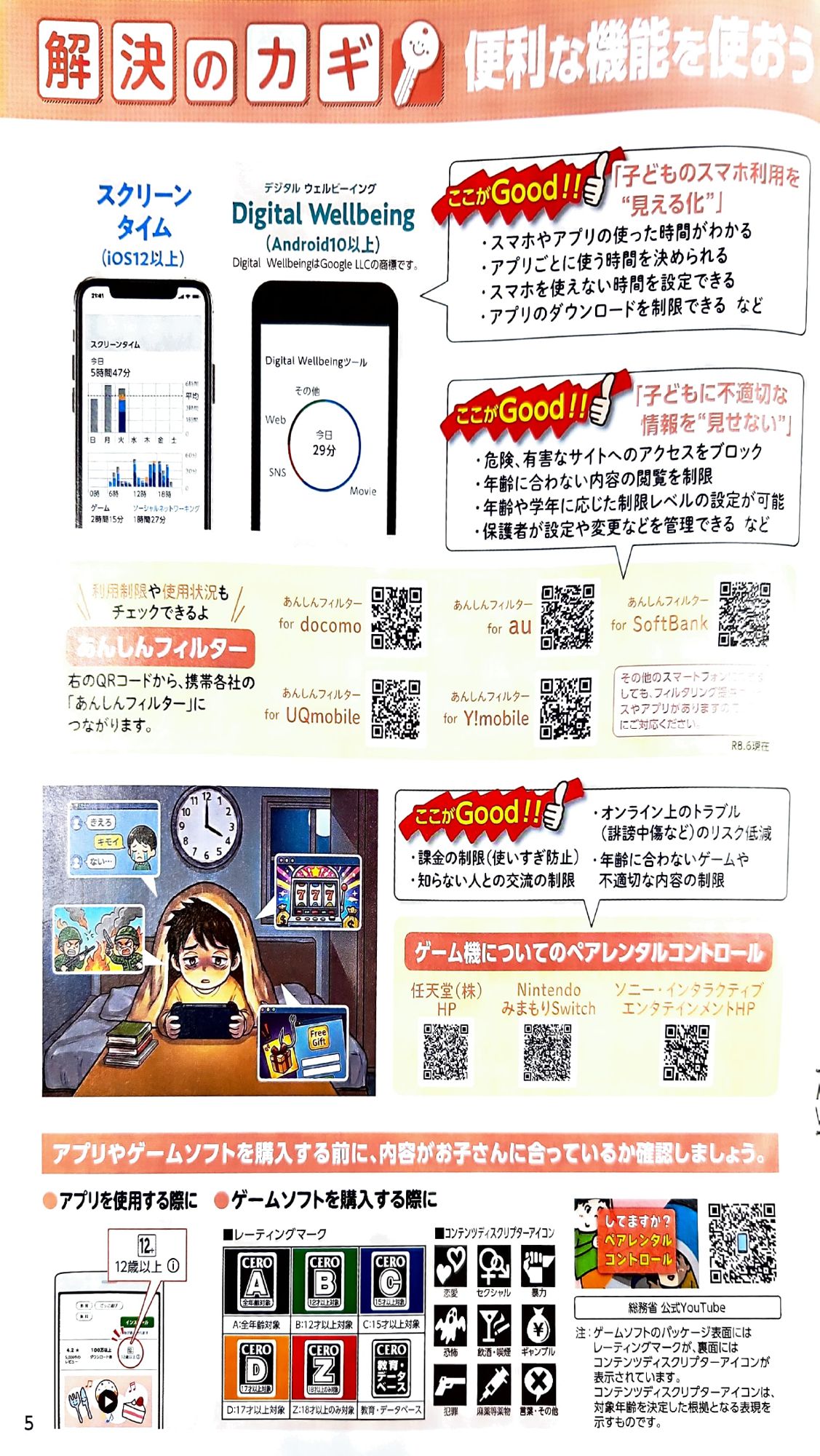
p.5 (scan p.13): Key to solutions: use handy functions (解決のカギ 便利な機能を使おう)
Screen Time (iOS 12+) / Digital Wellbeing (Android 10+). Good for "making your child's phone use visible": see how long the phone and each app were used; set time limits per app; set times when the phone can't be used; restrict app downloads, etc. Good for "not showing children inappropriate information": block dangerous or harmful sites; restrict viewing of content unsuitable for the child's age; set restriction levels by age or grade; parents manage settings and changes, etc.
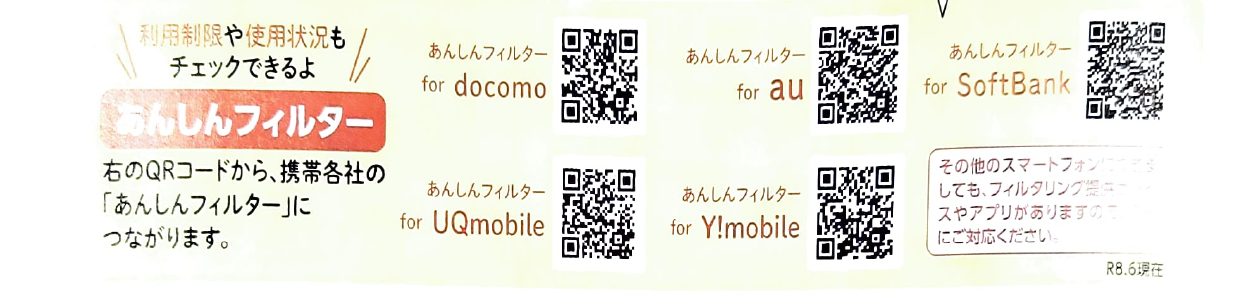
Anshin Filter (あんしんフィルター): you can also check usage limits and usage status. The QR codes link to each carrier's page (docomo, au, SoftBank, UQ mobile, Y!mobile). 「その他のスマートフォンにつきましても、フィルタリング提供サービスやアプリがありますので、(…)にご対応ください。」 R8.6現在: "Filtering services and apps are also available for other smartphones, so please set one up (listing as of June 2026)." (The end of the line is cut off in the scan.) Checked by a Japanese reader
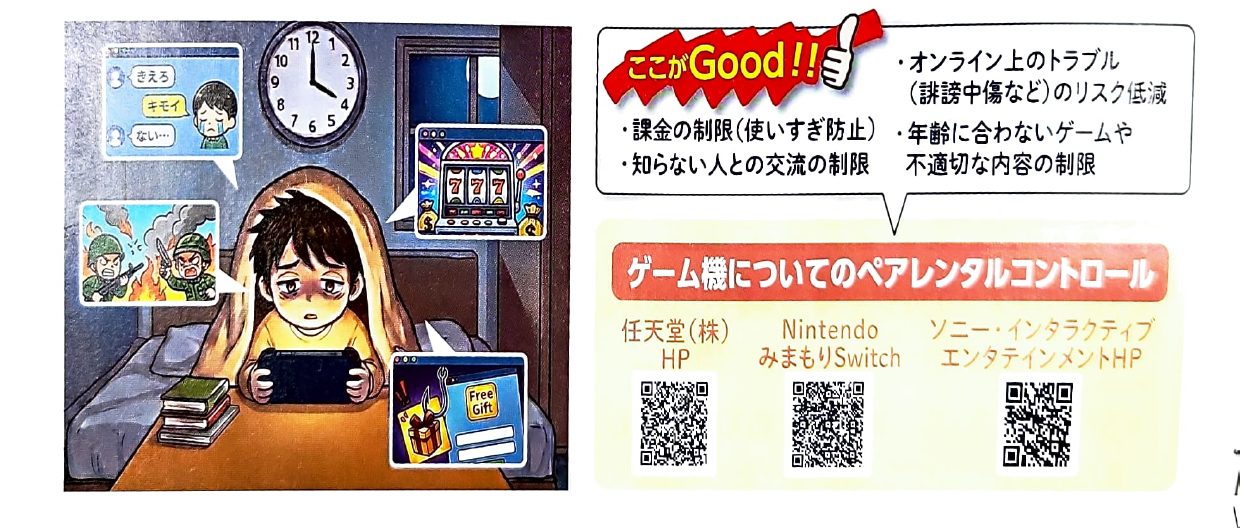
Parental controls for game consoles. Good for: limiting spending (prevents overuse); limiting interaction with strangers; reducing the risk of online trouble (abuse, etc.); restricting games and content unsuitable for the child's age. Links: Nintendo website, Nintendo みまもりSwitch, Sony Interactive Entertainment website.
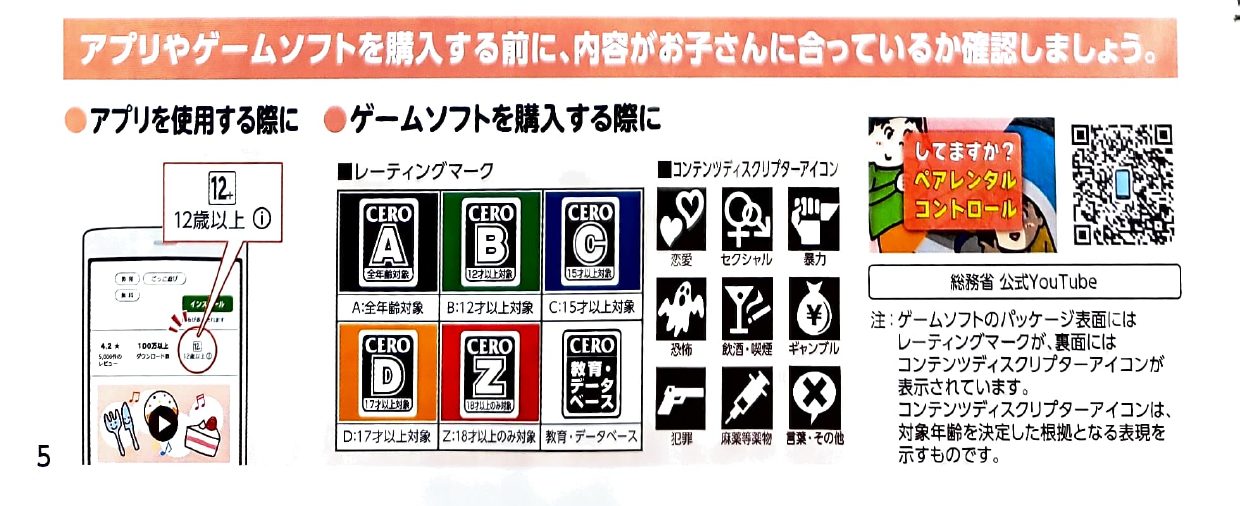
Before buying an app or game, check its content suits your child. Apps: check the age rating (e.g. "12+"). Game software: CERO rating marks: A all ages, B 12+, C 15+, D 17+, Z 18+ only, plus Education/Database. Content descriptor icons: romance, sexual content, violence, horror, drinking/smoking, gambling, crime, drugs, language/other. Note: the rating mark is on the front of the game package and the content icons are on the back; the icons show the grounds for the age rating. MIC official YouTube: "Are you using parental controls?"
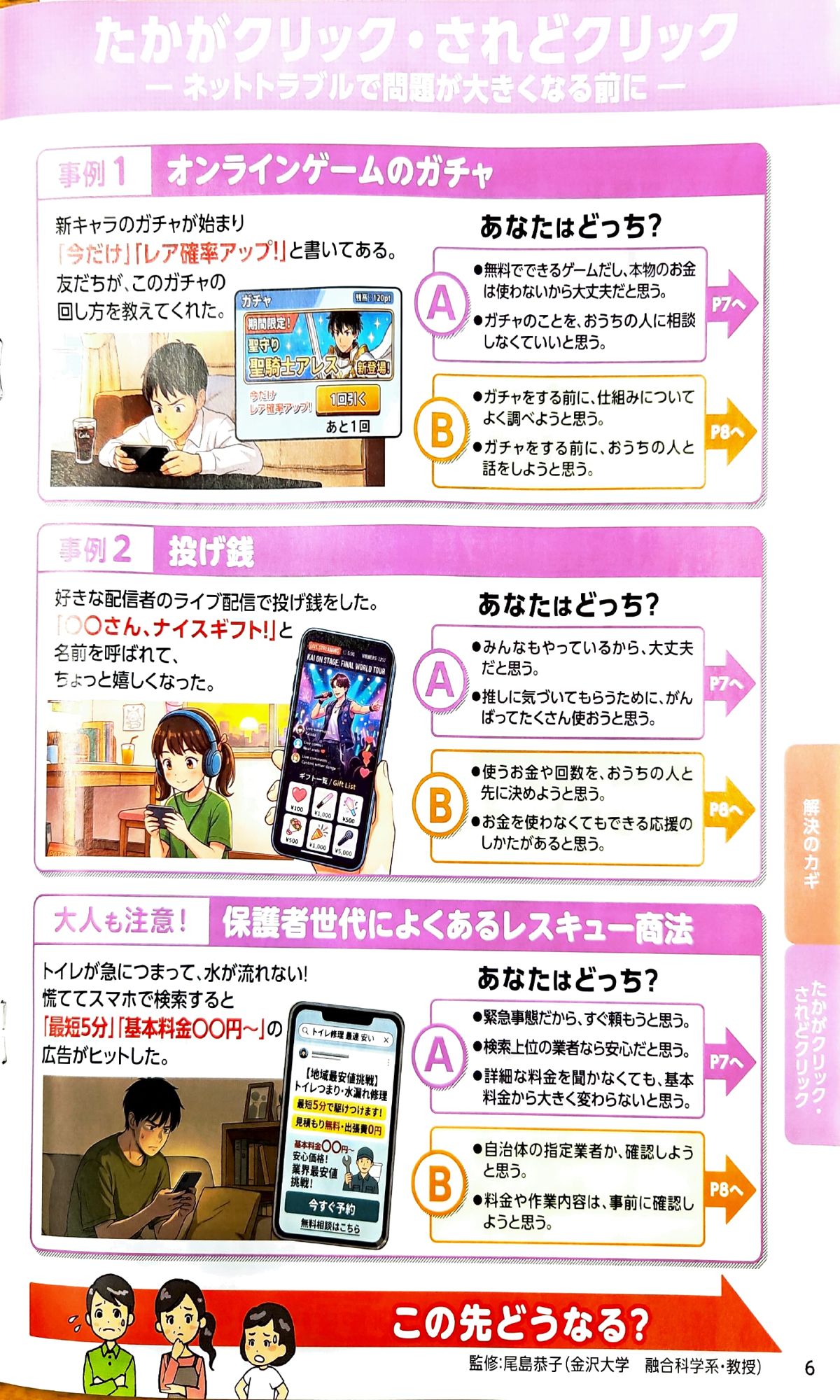
p.6 (scan p.14): "Just a click, but…" before net trouble grows (たかがクリック・されどクリック)
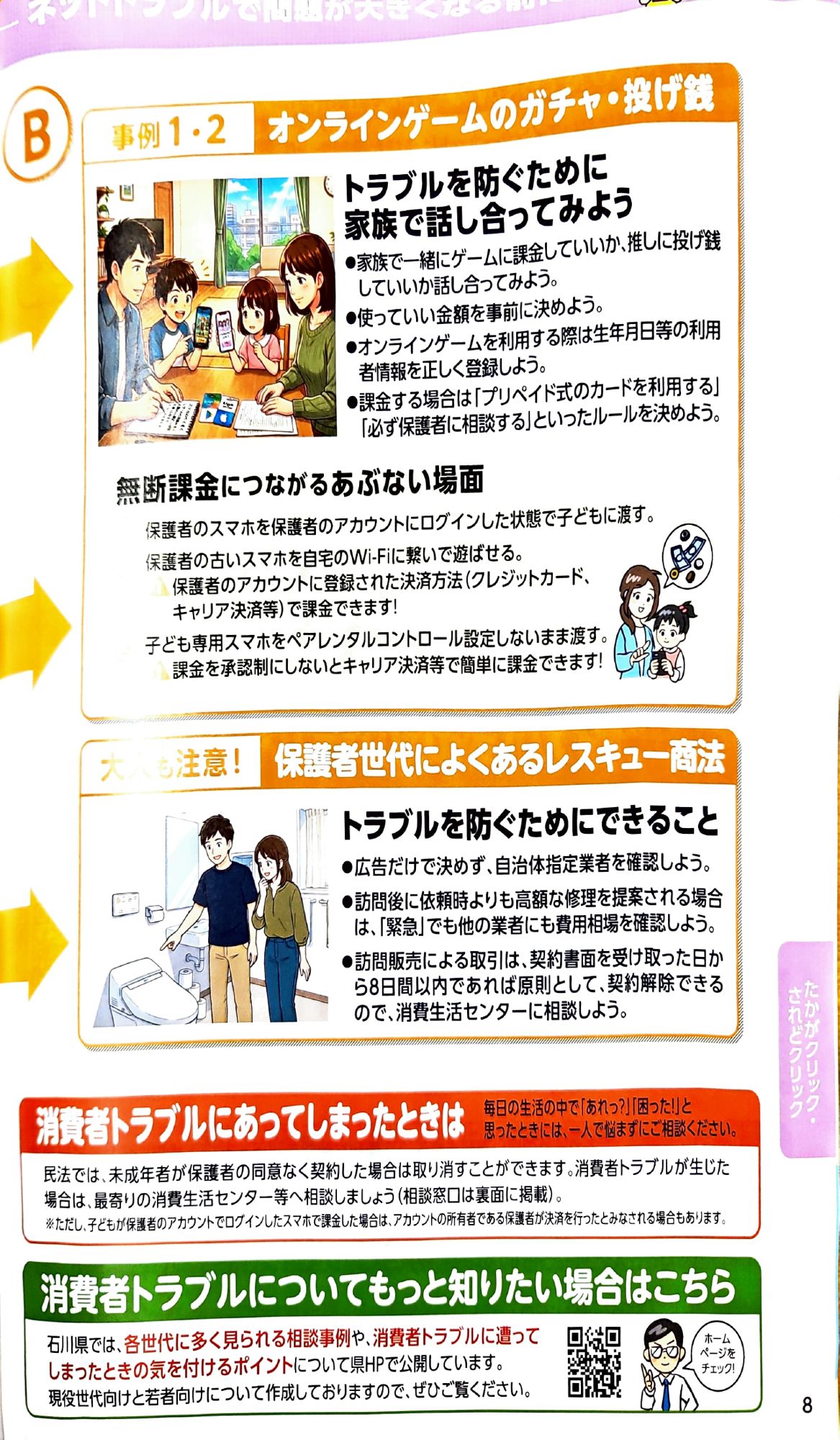
Case 1: online-game gacha (ガチャ). A new-character gacha starts, saying "This time only!" "Rare odds up!" A friend explained how to spin it. Which are you? A: "It's a free game and I don't use real money, so it's fine." "No need to talk to my family about gacha." (→ p.7) B: "I'll look into how gacha works first." "I'll talk to my family before playing." (→ p.8)
Case 2: tipping (投げ銭). Sent a tip in a favourite streamer's live stream. Was called out, "〇〇-san, nice gift!", and felt a bit happy. A: "Everyone does it, so it's fine." "I'll spend a lot so my favourite notices me." B: "I'll decide with my family how much and how often." "There are ways to support without spending money."
Adults, beware too! A "rescue scam" (レスキュー商法) common among parents' generation. The toilet is blocked and won't flush! In a panic you search on your phone and find an ad: "As fast as 5 minutes" "Basic fee ¥〇〇~". A: "It's an emergency, so I'll book at once." "Top search results must be safe." "Even without asking details, it won't cost much more than the basic fee." B: "I'll check whether they are a municipality-designated contractor (自治体の指定業者)." "I'll check the price and work beforehand." Supervised by 尾島恭子 (Professor, Kanazawa University).
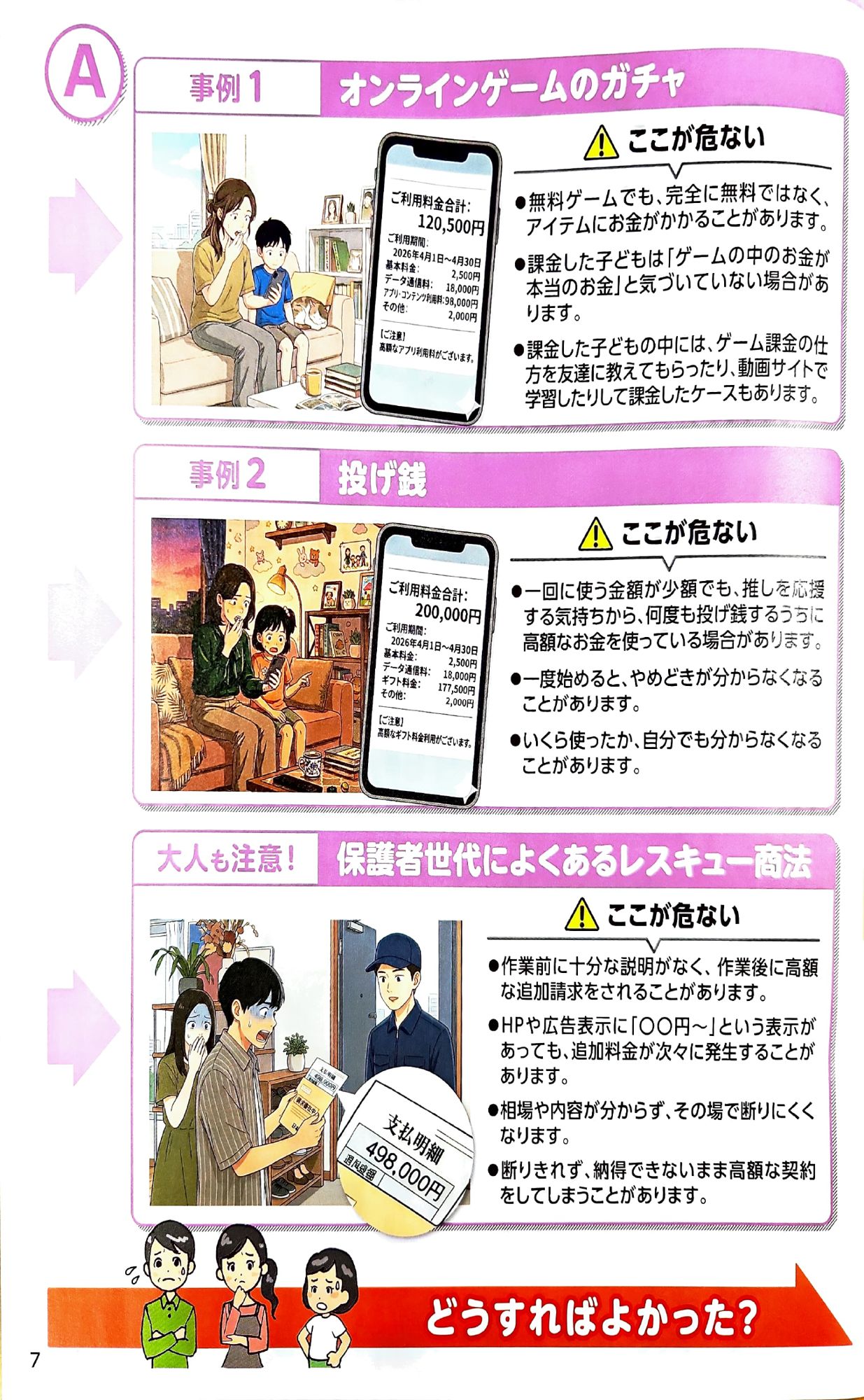
p.7 (scan p.15): If you chose A: here's the danger (ここが危ない)
Case 1 (bill ¥120,500): even free games aren't completely free, because items can cost money. Children who spend may not realise "in-game money is real money". Some children learned how to pay from friends or videos. Case 2 (bill ¥200,000): each tip may be small, but tipping again and again to support a favourite can add up to a lot of money. Once started, it's hard to know when to stop, and they may not know how much they've spent. Rescue scam (bill ¥498,000): with no proper explanation beforehand, you may be charged large extras after the work. Even if the website or ad says "¥〇〇~", extra fees may keep piling up. Without knowing the going rate or what's needed, it's hard to refuse on the spot, and you may end up in an expensive contract you aren't happy with.
p.8 (scan p.16): If you chose B: preventing trouble
Cases 1–2: talk it over as a family. Discuss together whether to pay in games or tip favourites; decide the amount beforehand; register the correct date of birth etc. when using online games; if paying, set rules such as "use prepaid cards" and "always ask a parent". Risky situations that lead to unauthorised spending: handing a child your phone while logged into your account; letting a child connect your old phone to home Wi-Fi (payment is possible with the payment methods on your account, such as credit card or carrier billing!); giving a child their own phone without parental controls (they can easily pay by carrier billing without approval!).
Rescue scam: what you can do. Don't decide from an ad alone; check for a municipality-designated contractor. If, after a visit, a repair costlier than you asked for is proposed, check the going rate with other contractors even if it's "urgent". For door-to-door sales, you can in principle cancel within 8 days of receiving the contract document; consult a consumer affairs centre.
If you run into consumer trouble: "If you think 'Huh?' or 'I'm stuck!' in daily life, don't worry alone. Ask for advice." Under the Civil Code, a contract a minor makes without parental consent can be cancelled. If consumer trouble occurs, consult your nearest consumer affairs centre (numbers on the back). ※However, if a child paid on a phone logged into a parent's account, the account holder (the parent) may be deemed to have made the payment. To learn more: Ishikawa Prefecture's website covers consultation cases common to each generation and tips if you've been caught out, with versions for working-age people and for young people.
p.9 (scan p.17): Making our family rules: introduction and hints
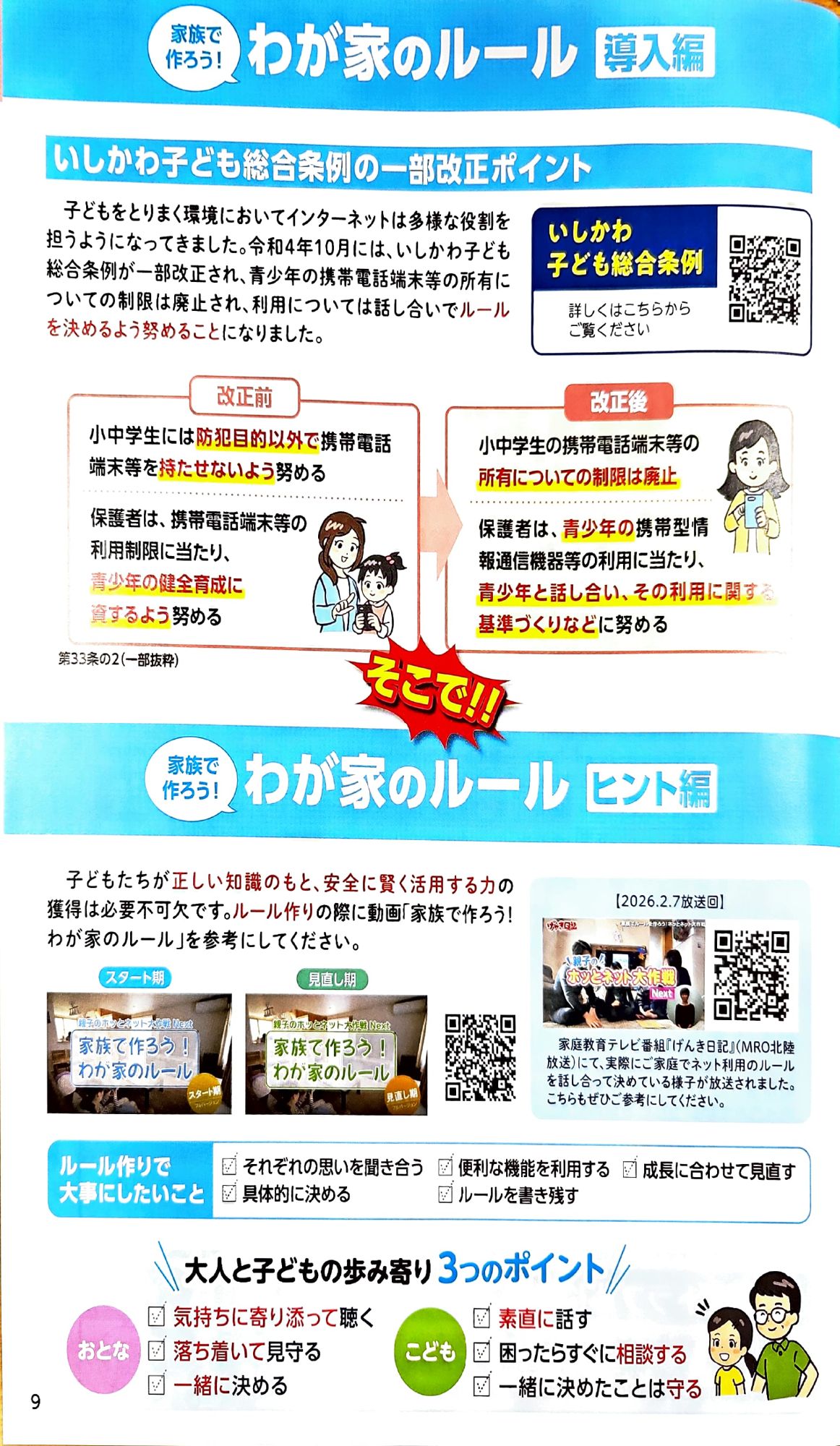
Key points of the partial revision of the Ishikawa Children's Comprehensive Ordinance. The internet plays many roles in children's lives. In October 2022 (令和4年10月) the ordinance was partly revised: the restriction on young people owning mobile phones was abolished, and families are instead to make an effort to decide usage rules through discussion. Before: "Endeavour not to let primary and junior-high pupils carry mobile phones except for crime prevention." "When restricting use, parents endeavour to contribute to healthy youth development." After: "The restriction on primary and junior-high pupils owning mobile phones is abolished." "Parents endeavour to talk with young people about their use of mobile devices and to set standards for that use." (Article 33-2, excerpt.)
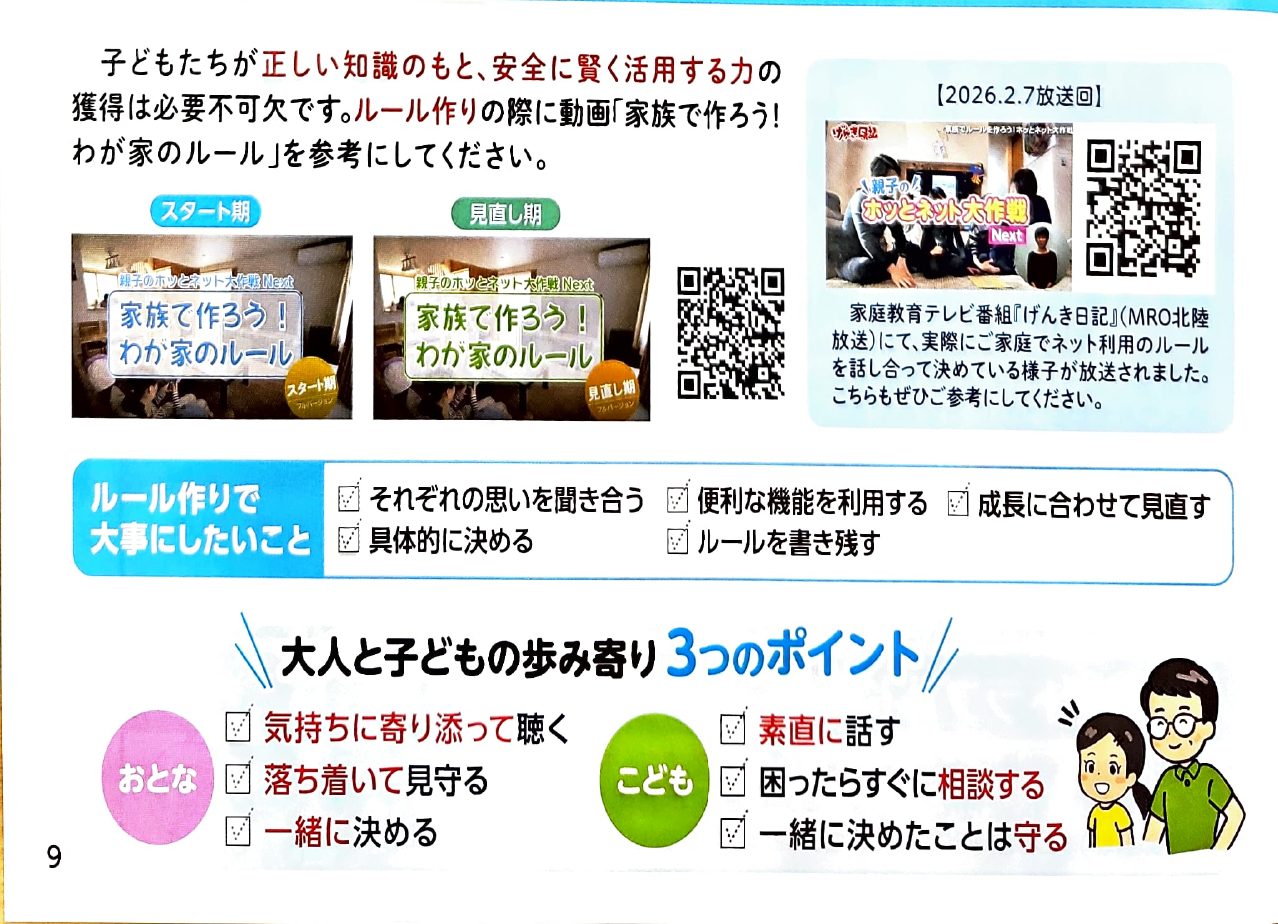
Hints. It is essential that children gain the ability to use the internet safely and wisely, based on correct knowledge. When making rules, refer to the videos "Let's make our family rules" (start stage and review stage). In the home-education TV programme げんき日記 (MRO, broadcast 7 Feb 2026), a family was shown actually discussing and deciding internet rules; please take a look. Important in making rules: listen to each other's feelings; use handy functions; review as the child grows; decide concretely; write the rules down. 3 points for adults and children to meet halfway: Adults: listen empathetically, watch calmly, decide together. Children: speak honestly, ask for help straight away when in trouble, keep what you decided together.
p.10 (scan p.18): Our family rules: start stage (form)
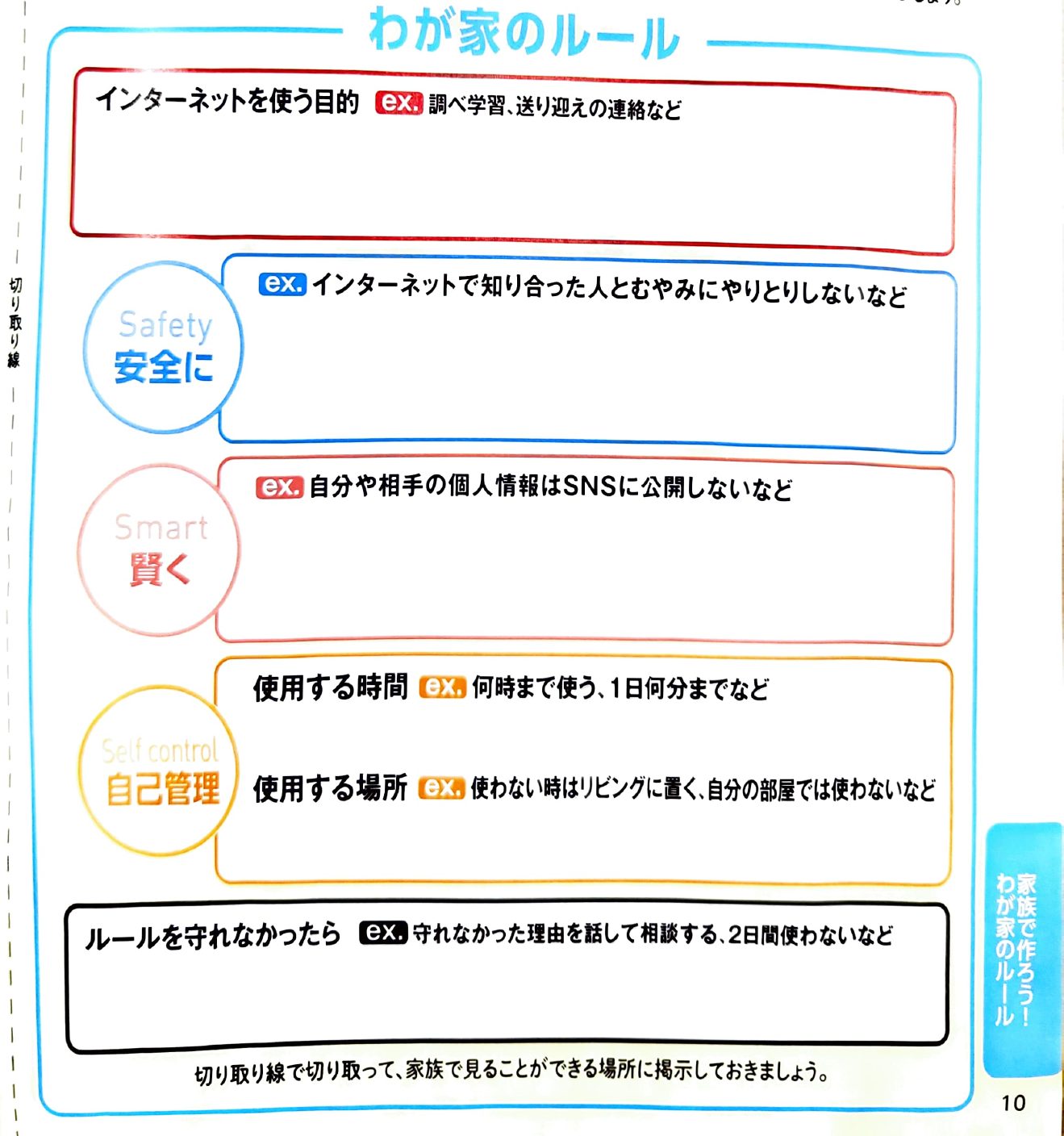
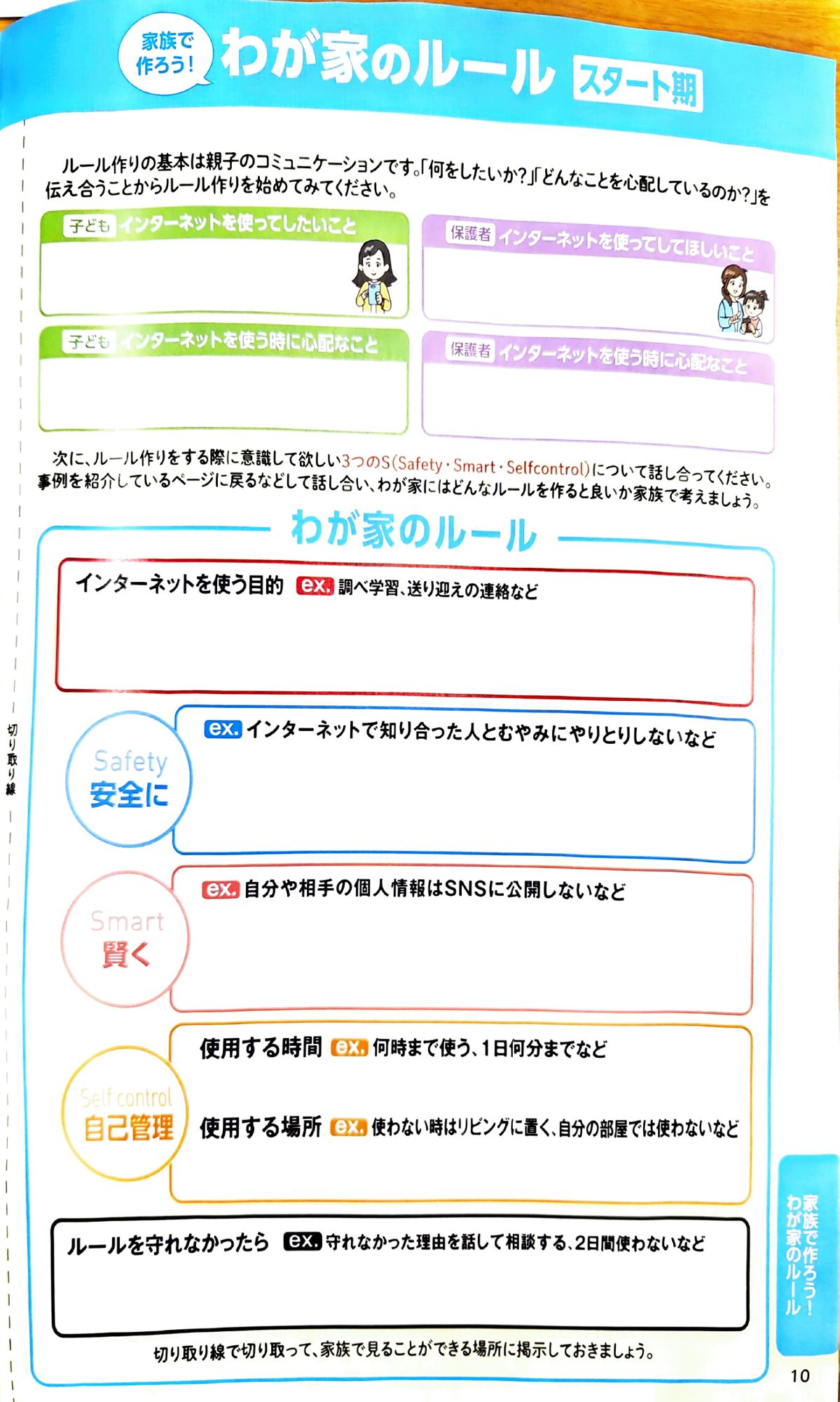
The basis of rule-making is parent–child communication. Start by sharing "What do you want to do?" and "What are you worried about?" Boxes: Child: what I want to use the internet for / what worries me about using it. Parent: what I'd like you to use it for / what worries me. Next, talk about the 3 S's (Safety, Smart, Self-control), going back to the case pages, and think as a family about what rules suit you.
Our family rules (わが家のルール): purpose of using the internet (e.g. research, contacting about pick-ups); Safety 安全に (e.g. don't casually interact with people met online); Smart 賢く (e.g. don't publish your own or others' personal information on SNS); Self-control 自己管理: time (e.g. until what time, how many minutes a day) and place (e.g. leave it in the living room when not using it, don't use it in your own room); if rules aren't kept (e.g. explain why and talk it over, no use for 2 days). Cut along the line and post it where the whole family can see.
p.11 (scan p.19): Our family rules: review stage
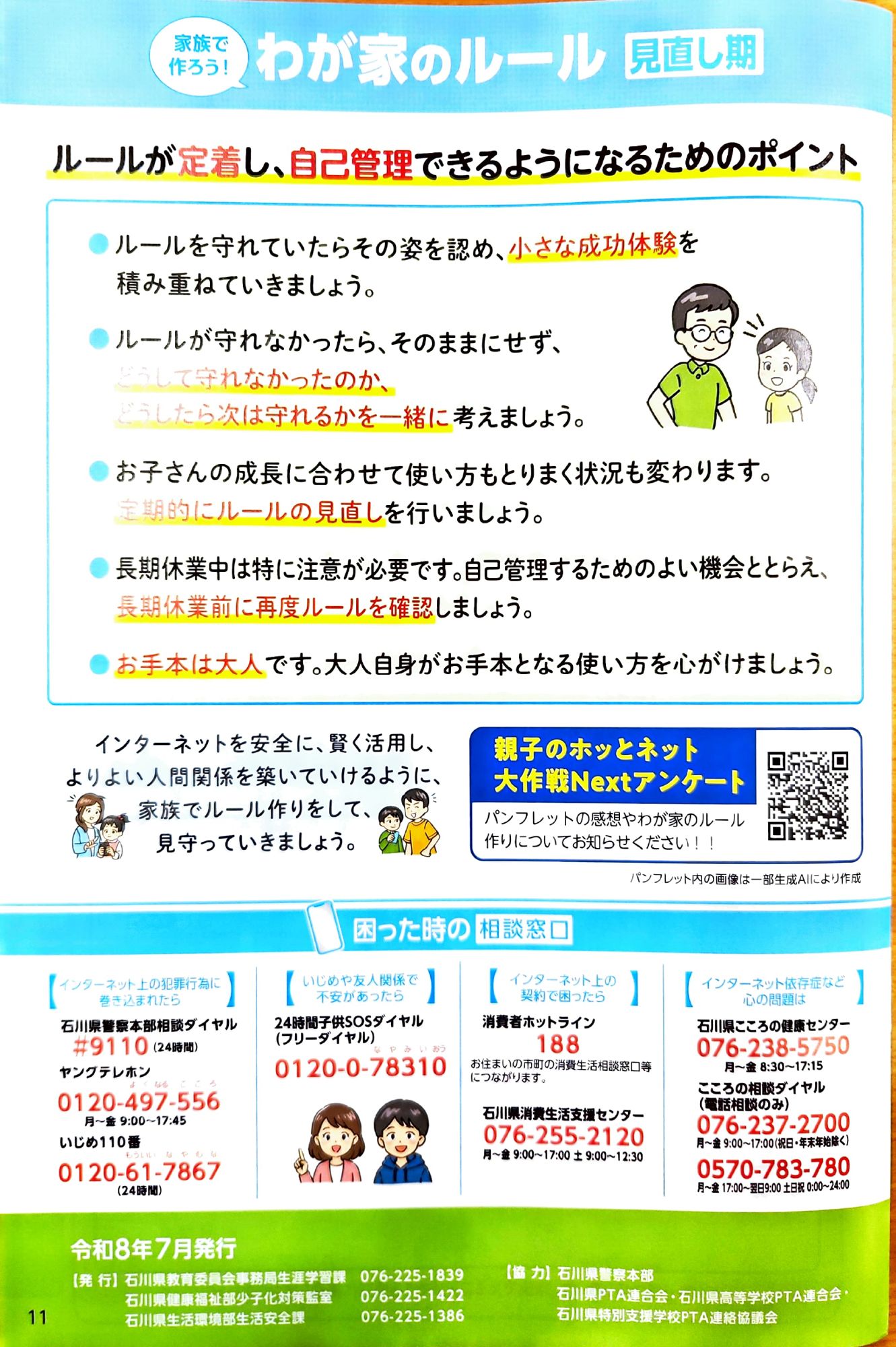
Points for making rules stick and building self-management: when your child keeps the rules, recognise it and build up small successes. If rules aren't kept, don't let it slide; think together about why and how to keep them next time. As the child grows, how they use devices and their situation change, so review the rules regularly. Long holidays need special care; treat them as a good chance for self-management and re-check the rules before them. Adults are the model. Use devices in a way that sets an example.
So that children use the internet safely and wisely and build good relationships, make rules as a family and keep watching over them. Survey: "Tell us your thoughts on the booklet and your family rules!" (QR code). Some images in the booklet were generated by AI. Helplines: see the key facts table.
Images
Original pages (tap to open full size):
"The all-important first year": parent leaflet
Information
肝心かなめの1年生(新小学1年生保護者向け)
In short
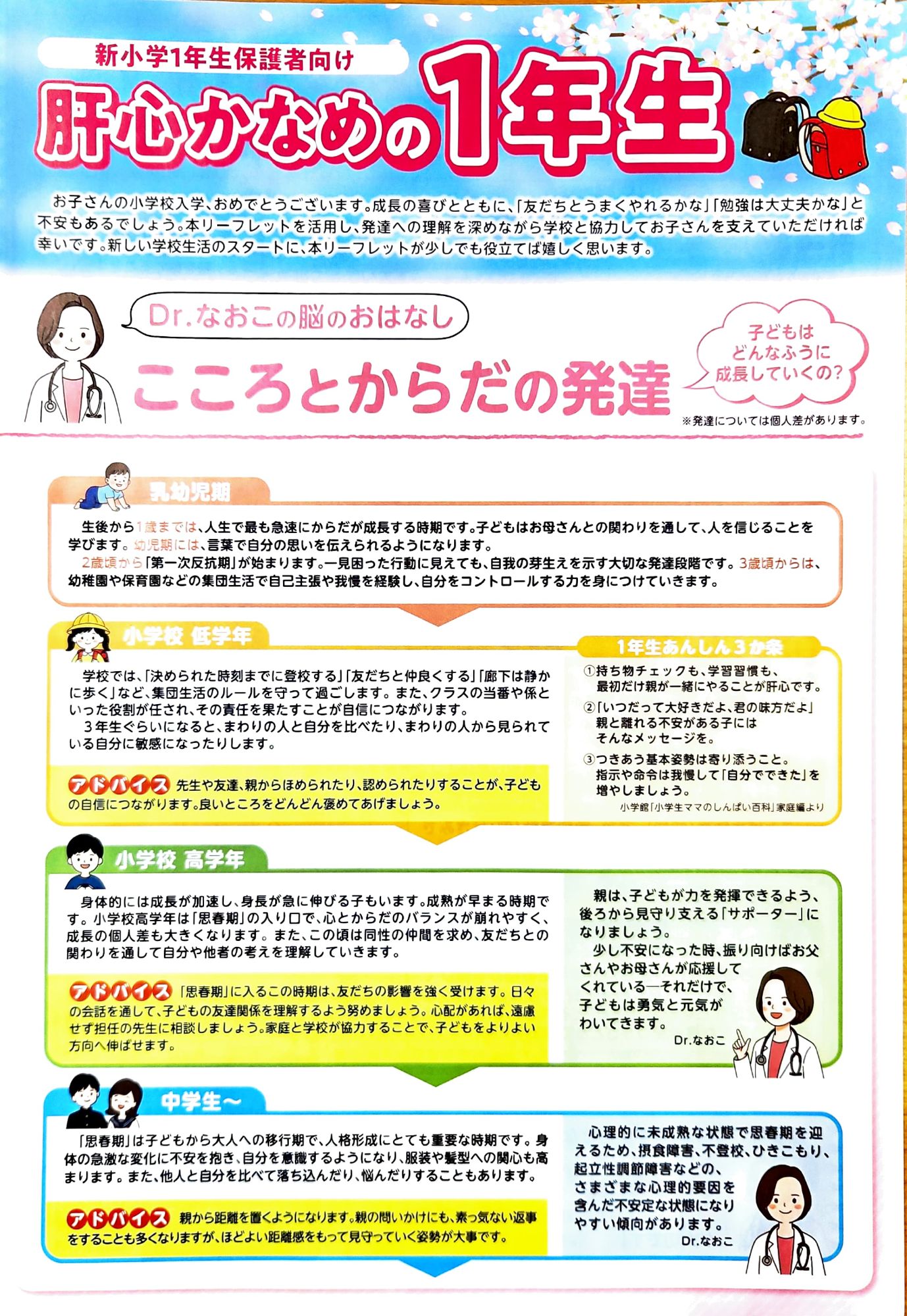
Fact A general prefectural leaflet for parents of new first-graders about child development, sleep (about 9 hours, asleep by 10 pm, screens off an hour before bed) and breakfast, with links to help services. It has no action and no deadline.
The "3 peace-of-mind rules for first-graders" box is worth reading before school starts, whatever school your child attends. Checked by a Japanese reader
Key facts
| For | Parents of new first-graders |
|---|---|
| Action / deadline | None |
| Key numbers | Children need about 9 hours' sleep. Growth-hormone peak is 11 pm–2 am. Stop screens 1 hour before bed |
| Help services (QR codes) | List of consultation services (PDF, Ishikawa Pref.) "Papa & mama worries" Q&A (PDF) げんき日記 TV programme page (short link → Ishikawa Pref. TV/radio page) |
| Publisher | 石川県教育委員会事務局 生涯学習課, 〒920-8575 石川県金沢市鞍月1丁目1番地 ↗ · 076-225-1839 |
Action checklist
- Read the "3 rules" box before school starts
Who: Parents · When: Before April 2027 - Aim for about 9 hours' sleep (asleep by 10 pm) and screens off 1 hour before bed
Who: Parents · When: Ongoing - Save the help-services PDF link
Who: Parent · When: Any time
Full English interpretation
p.1 For parents of new first-graders: the all-important first year (肝心かなめの1年生)
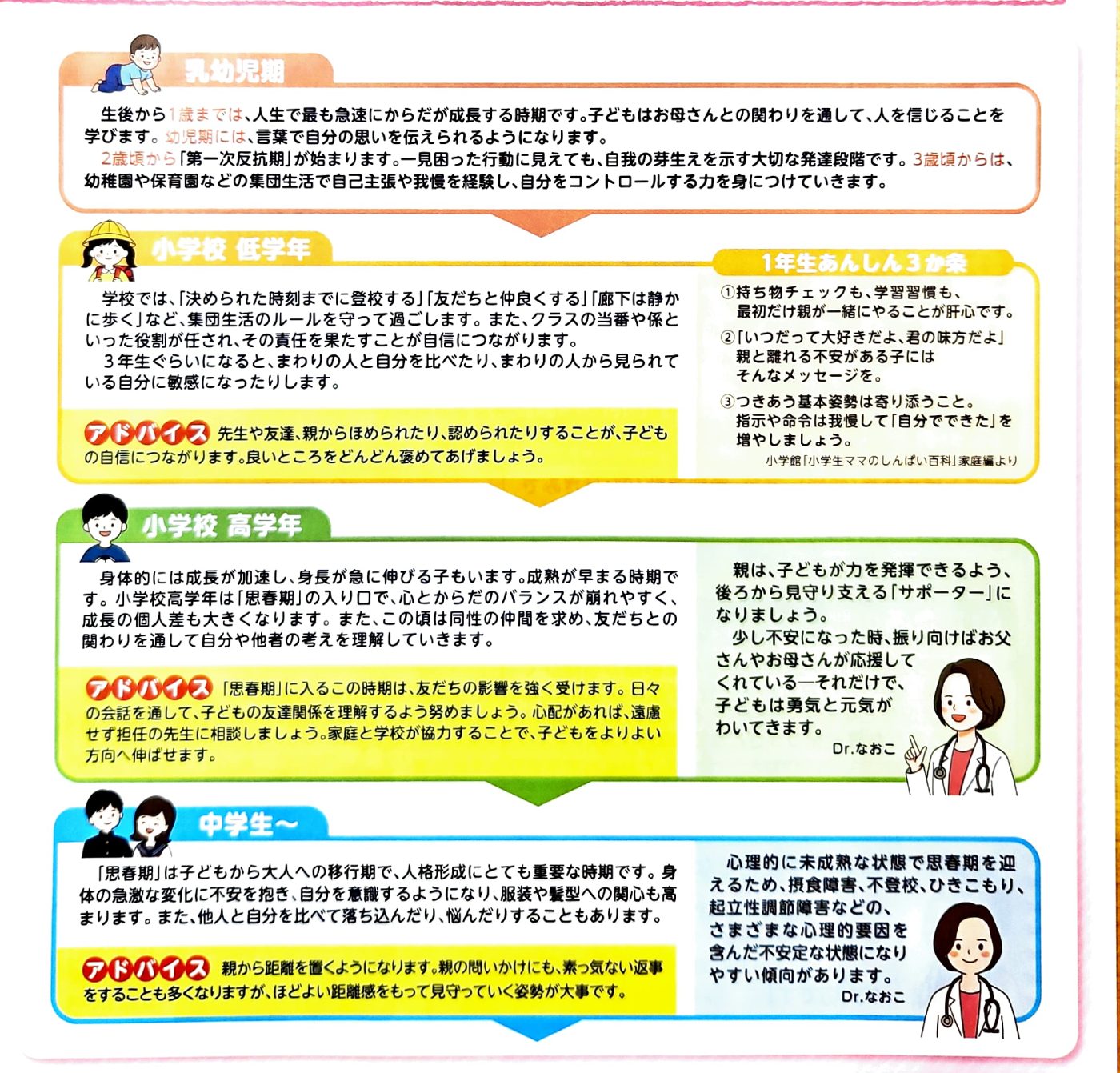
Congratulations on your child starting elementary school. Along with the joy of seeing them grow, you may also feel anxious: "Will they get on with friends?" "Will they cope with the study?" We would be glad if you used this leaflet to deepen your understanding of child development and to support your child in cooperation with the school. We hope it helps a little as school life begins.
Dr Naoko's brain talk: development of mind and body. How do children grow? (※Development differs from child to child.)
Infancy (乳幼児期). From birth to age 1, the body grows faster than at any other time of life. Through their relationship with their mother, children learn to trust people. In early childhood they become able to express their feelings in words. From about age 2 the "first rebellious phase" (第一次反抗期) begins. Though the behaviour may look troublesome, it is an important stage showing the budding of a sense of self. From age 3, through group life at kindergarten or nursery, children experience asserting themselves and holding back, and develop self-control.
Lower elementary (小学校低学年). At school, keeping group rules ("arrive by the set time", "get on with friends", "walk quietly in the corridor") and being given class roles such as duty monitor (当番), then fulfilling them, builds confidence. Around 3rd grade, children start comparing themselves with others and become sensitive to how others see them. Advice: being praised and recognised by teachers, friends and parents builds a child's confidence. Praise their good points plenty.
① Check belongings and study habits together, but only at the beginning. That's the key.
② "I'll always love you. I'm on your side." Children who hear this message from their parents feel less anxious about being apart from them, so tell them.
③ Your basic stance: stay alongside them (寄り添う). Resist giving instructions and orders, and let them have more 'I did it myself!' moments. Checked by a Japanese reader
Source: 小学館『小学生ママのしんぱい百科』
Upper elementary (小学校高学年). Growth speeds up and height shoots up, and some children mature early. Upper elementary is the doorway to puberty (思春期). The balance of mind and body can wobble, and differences between children widen. Through same-sex friendships, children come to understand themselves and others. Advice: at the start of puberty, friends have a strong influence. Through daily conversation, try to understand your child's friendships. If you're worried, consult the class teacher (担任) without hesitation. Home and school working together helps the child grow in a good direction.
Dr Naoko: Parents should be "supporters" who watch from behind so the child can use their own strength. Even when they feel anxious, if they look back and see Dad or Mum cheering them on, that alone gives children courage and energy.
Junior high onward (中学生〜). Puberty is the transition from child to adult and very important for forming character. Sudden bodily changes bring anxiety and self-consciousness, and interest in clothes and hairstyles grows. Children may compare themselves with others and feel low or troubled. Advice: they start keeping distance from parents and often give curt replies, but it's important to watch over them from a moderate distance.
Dr Naoko: Because they enter puberty while still psychologically immature, children can become prone to unstable states involving psychological factors, such as eating disorders, school refusal (不登校), social withdrawal (ひきこもり) and orthostatic dysregulation (起立性調節障害).
p.2 Dr Naoko: early to bed, early to rise, breakfast. Let's power up the brain (脳のはたらきを活発にしよう)
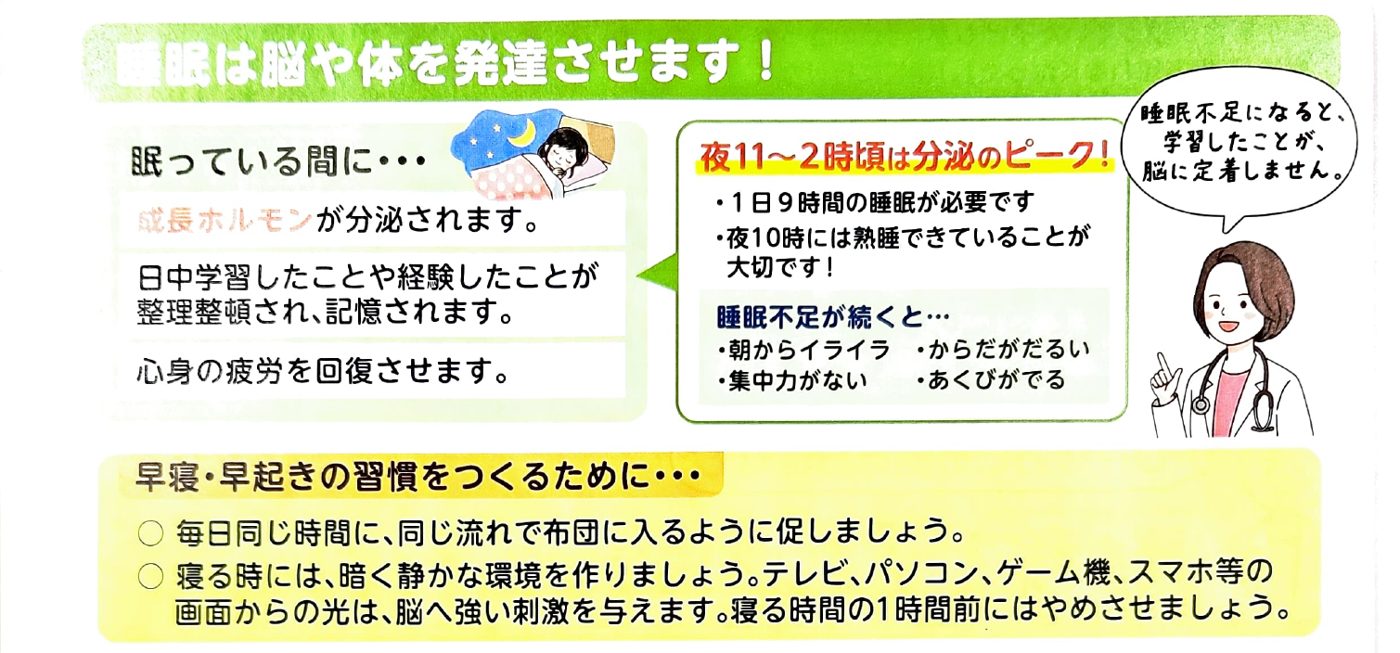
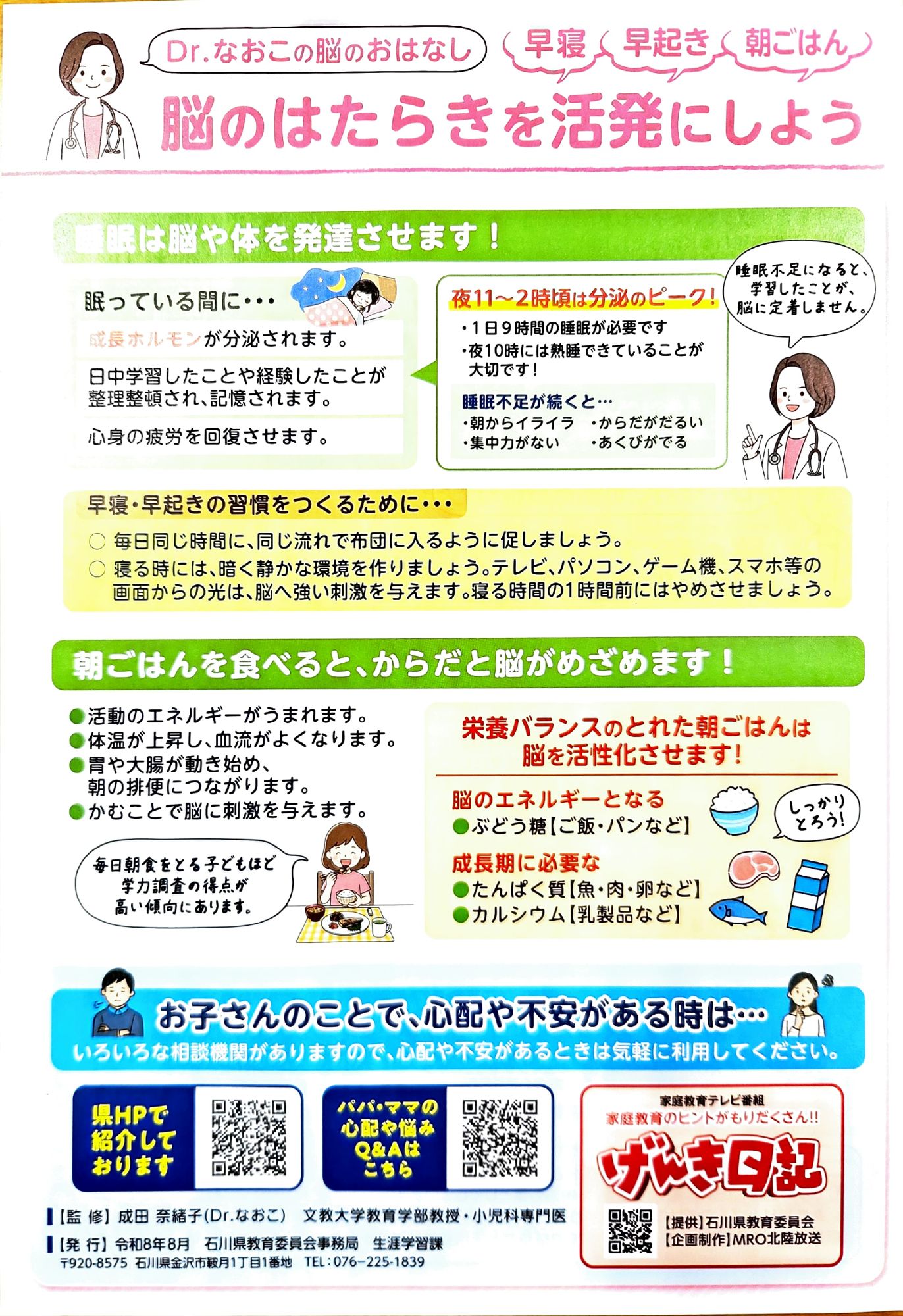
Sleep develops brain and body! While asleep: growth hormone (成長ホルモン) is released; what was learned and experienced in the day is sorted and stored as memory; and mental and physical tiredness is recovered. 11 pm–2 am is the peak of secretion! Children need 9 hours of sleep a day, and being in deep sleep by 10 pm is important. If lack of sleep continues: irritable from the morning, can't concentrate, body feels heavy, keeps yawning. (Speech bubble: "When children are short of sleep, what they learned doesn't stick in the brain.")
To build early-to-bed, early-to-rise habits: encourage your child to go to bed (布団) at the same time with the same routine every day. At bedtime, make the room dark and quiet. Light from TV, computer, game-console and smartphone screens strongly stimulates the brain, so have them stop one hour before bed.
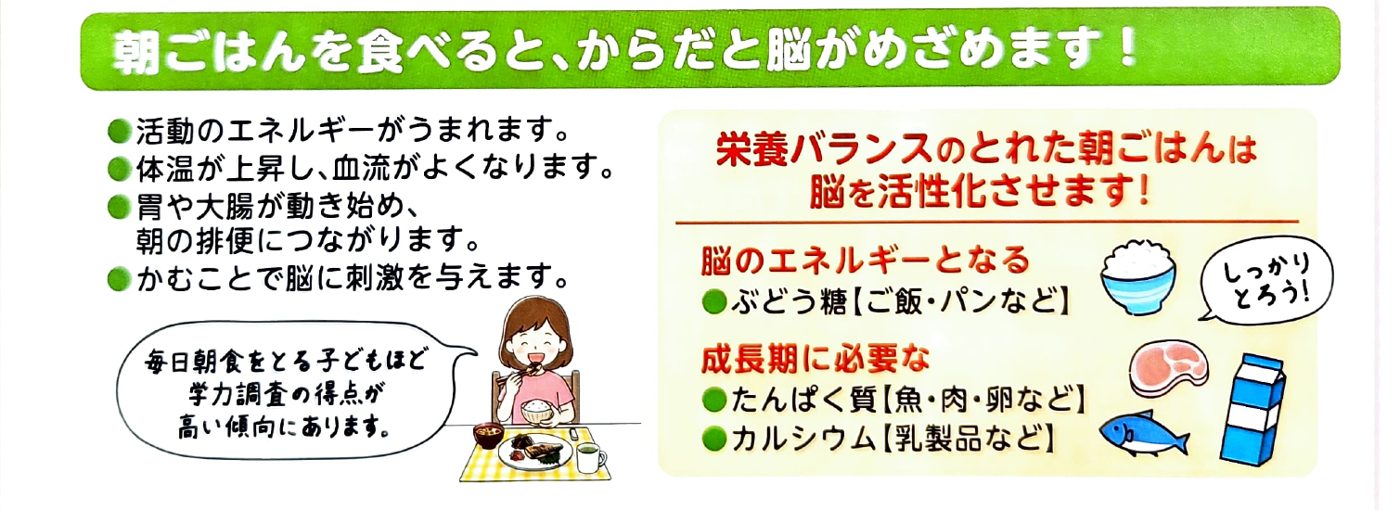
Breakfast wakes up body and brain! It produces energy for activity; raises body temperature and blood flow; gets the stomach and gut moving, leading to a morning bowel movement; and chewing stimulates the brain. Children who eat breakfast every day tend to score higher in academic-ability surveys. A nutritionally balanced breakfast activates the brain. Energy for the brain: glucose (rice, bread). Needed for growth: protein (fish, meat, eggs) and calcium (dairy). "Chew well!"
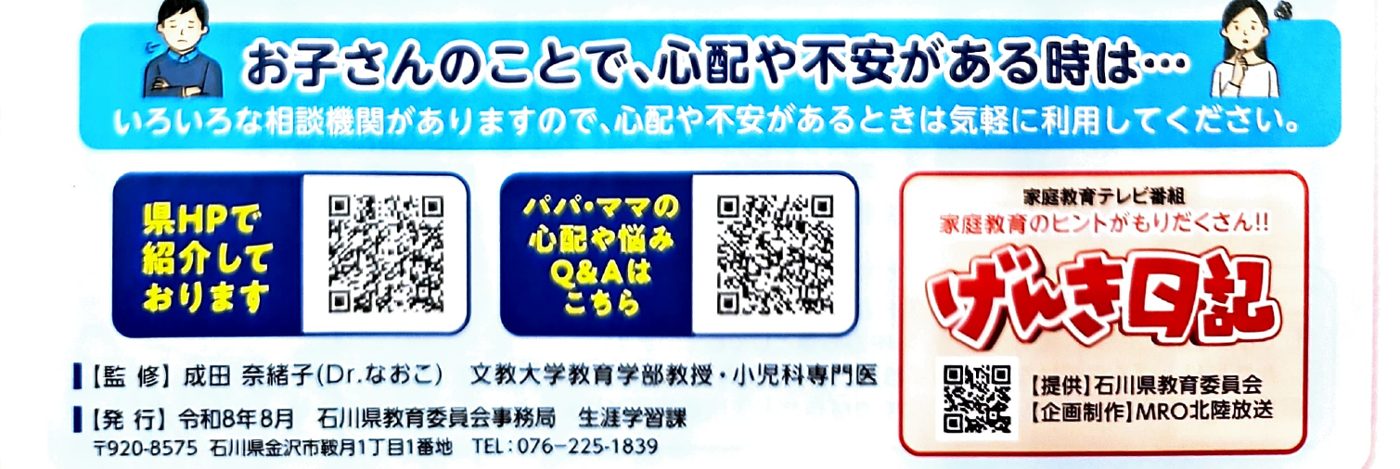
When you are worried or anxious about your child… there are many consultation services, so please feel free to use them. QR codes: "Introduced on the prefectural website"; "Papa and Mama's worries: Q&A here"; home-education TV programme げんき日記 ("packed with tips on home education"), provided by the Ishikawa Pref. Board of Education and produced by MRO北陸放送.
Supervised by: 成田奈緒子 (Dr Naoko), Professor, Faculty of Education, Bunkyo University; paediatric specialist. Published August 2026 (令和8年8月) by the Ishikawa Prefectural Board of Education Secretariat, Lifelong Learning Division.
Images
Original pages (tap to open full size):
Handwashing and infection-prevention videos
Information
ていねいに手を洗いましょう / 目指しまっし!感染症マスター
In short
Fact A Kanazawa health-centre sheet that encourages careful handwashing, with links to a handwashing song video (to the tune of "Twinkle Twinkle") and ten short videos on infections and food poisoning. It has no action and no deadline, and it isn't tied to any school.
Key facts
| When to wash hands | After coming home from outside · before meals and snacks · after the toilet |
|---|---|
| Handwashing video | てあらいプロジェクトかなざわ (city page) |
| Infection videos | 金沢市保健所チャンネル (YouTube via city page) |
| Contact | 金沢市保健所, 金沢市西念3-4-25 ↗ · 076-234-5102 |
Action checklist
- Watch the handwashing video together with your children (optional)
Who: Parent · When: Any time
Full English interpretation
Wash your hands carefully (ていねいに手を洗いましょう)
Children have weak resistance to illness, so they catch infections easily. To prevent infection, it is important to stop germs (病原体, ばい菌) getting into the body.
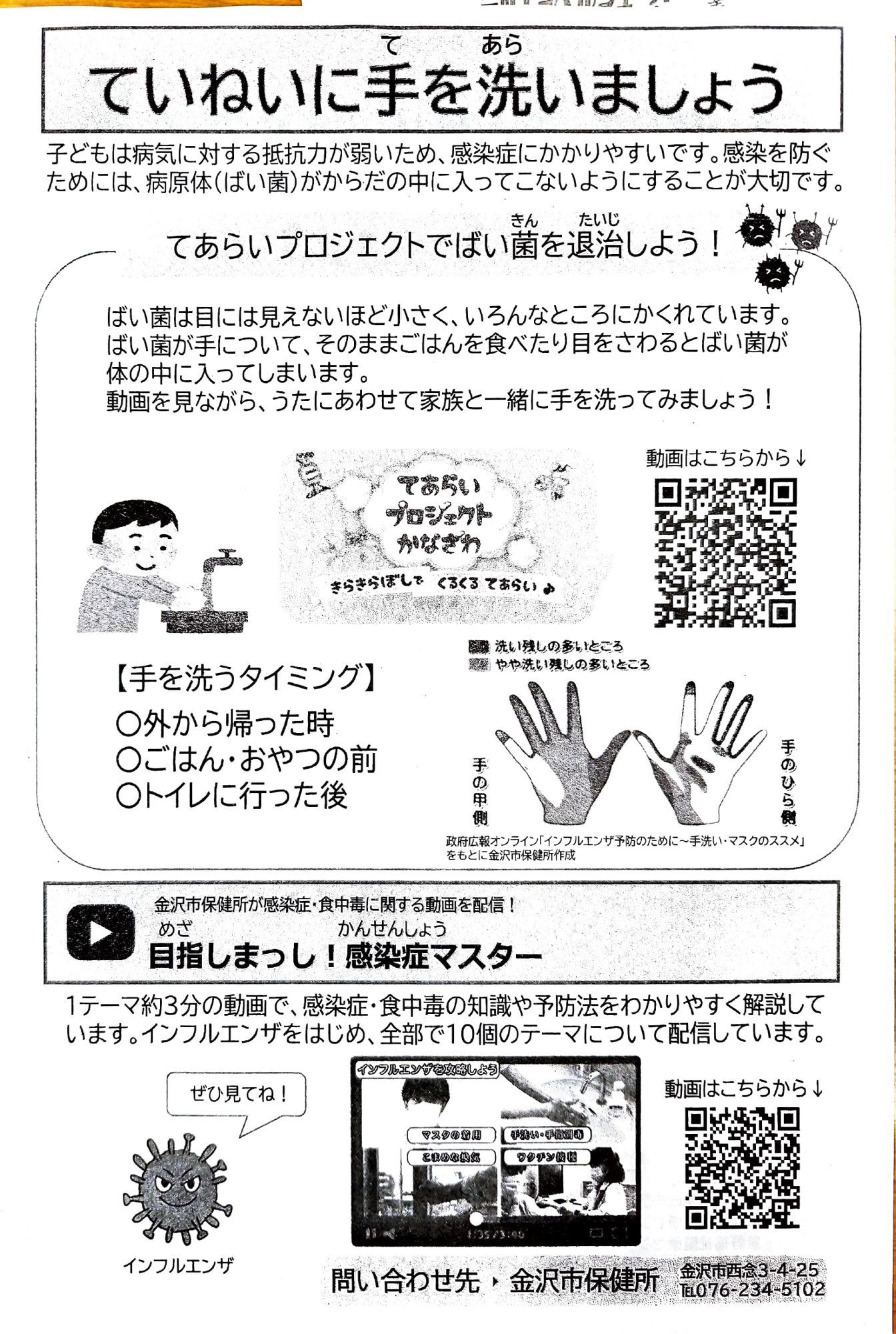
Beat the germs with the Handwashing Project (てあらいプロジェクトでばい菌を退治しよう!) Germs are too small to see and hide in all sorts of places. If germs get on your hands and you then eat or touch your eyes, they get into your body. Watch the video and wash hands with your family in time to the song! (Video: "Te-arai Project Kanazawa: twinkle-twinkle, round-and-round handwashing".)
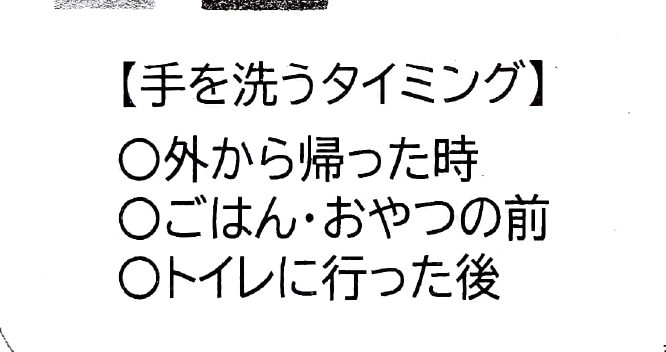
When to wash hands (手を洗うタイミング): ○ when you come home from outside ○ before meals and snacks ○ after going to the toilet.
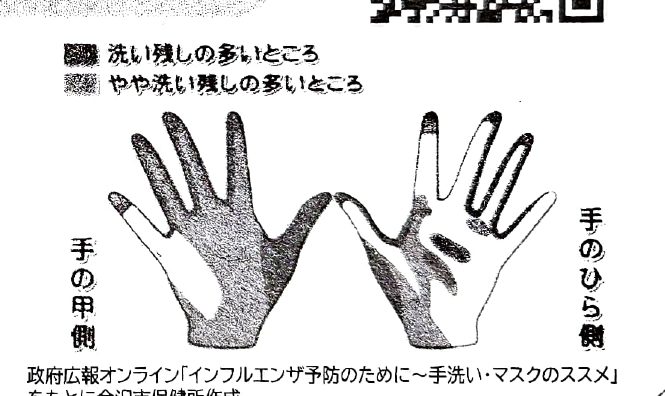
Diagram: back of hand (手の甲側) and palm (手のひら側). Dark areas = places often missed (洗い残しの多いところ); lighter shading = places fairly often missed. Based on the government PR site "Handwashing and masks to prevent influenza".
Aim to be an infection master! (目指しまっし!感染症マスター)
The Kanazawa Public Health Centre streams videos on infectious diseases and food poisoning. Each theme is about 3 minutes and explains knowledge and prevention clearly. There are 10 themes in total, starting with influenza. "Please watch!"
Images
Original pages (tap to open full size):
Use of school grounds after school
Information (city public schools)
放課後等のグラウンド等の学校施設の開放について(お願い)
In short
Fact Kanazawa opens city school grounds and gyms to registered community groups outside school hours. Groups with permission have priority, so children going onto a ground in use should take care. There's nothing to apply for.
Private school? This notice covers Kanazawa city public schools. Private schools set their own rules for their own grounds.
Key facts
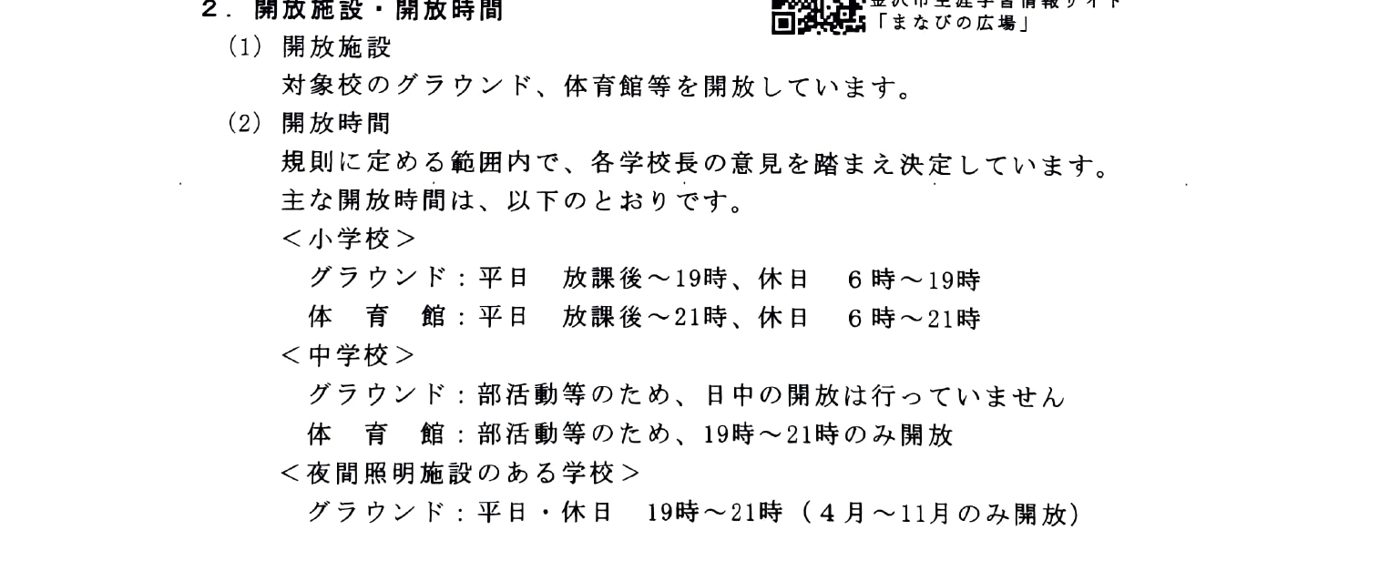
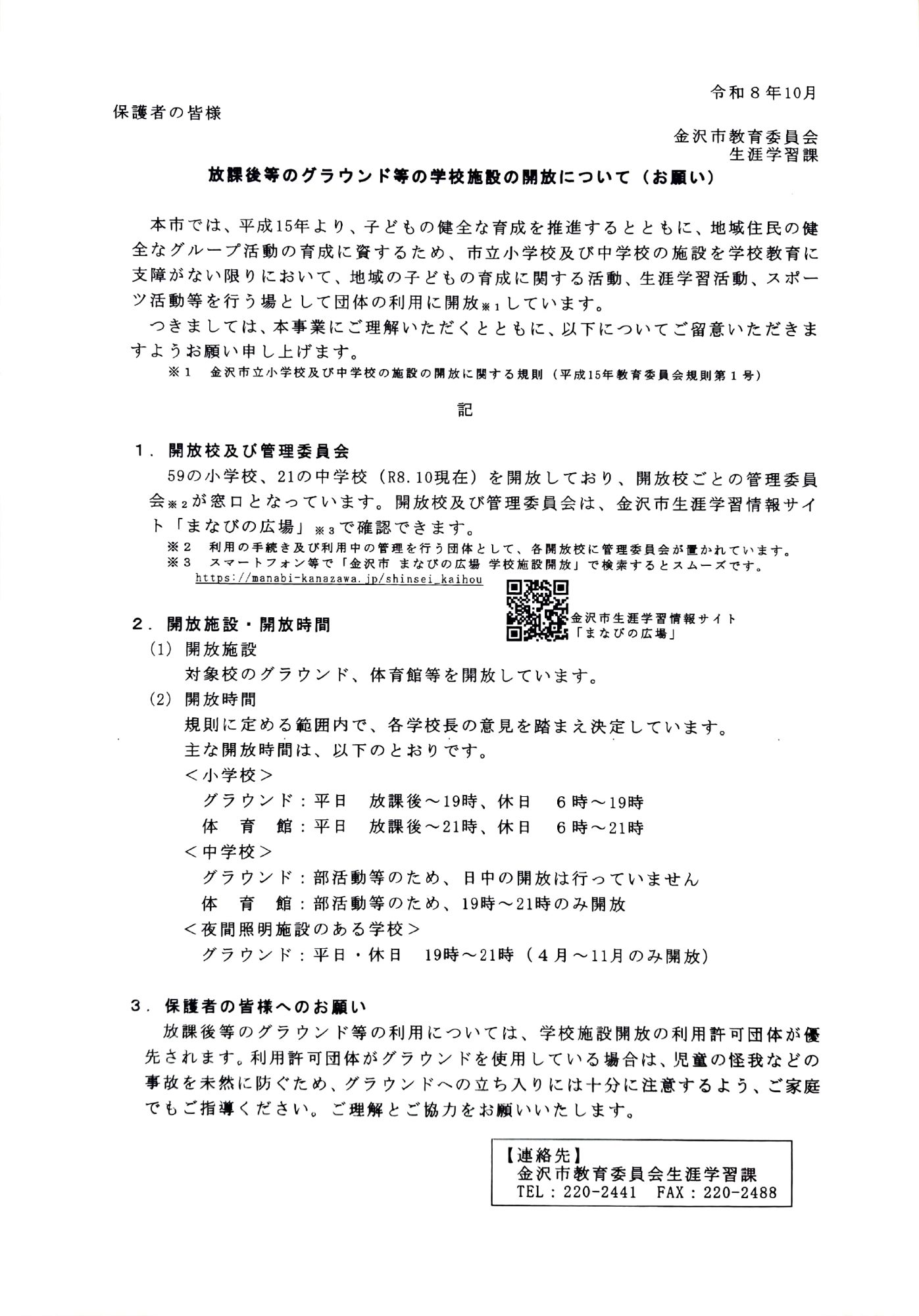
| Primary schools | Ground: weekdays after school–19:00, holidays 6:00–19:00 · Gym: weekdays after school–21:00, holidays 6:00–21:00 |
|---|---|
| Junior high | Ground: not opened in the daytime (club activities) · Gym: 19:00–21:00 only |
| Schools with floodlights | Ground: weekdays and holidays 19:00–21:00 (April–November only) |
| Which schools | 59 primary and 21 junior high schools (as of October 2026). See まなびの広場 (printed URL and QR code) |
| Contact | 金沢市教育委員会 生涯学習課 076-220-2441 · FAX 076-220-2488 |
Action checklist
- Remind your child to keep clear of teams using a school ground after school
Who: Parent · When: When school starts
Full English interpretation
October 2026 · To parents (保護者の皆様) · Kanazawa City Board of Education, Lifelong Learning Division
Opening of school facilities such as grounds after school (request)
Since 2003 (平成15年), to promote children's healthy development and to support healthy group activities among local residents, the city has opened city primary and junior-high school facilities to groups (※1) as places for children's activities, lifelong learning and sports, as long as this doesn't interfere with school education. We ask for your understanding of this programme and for your attention to the following. (※1 Kanazawa City rules on opening city primary and junior-high facilities, Board of Education Rule No. 1, 2003.)
1. Schools opened and management committees. 59 primary and 21 junior-high schools (as of October 2026, R8.10) are open, and each school's management committee (管理委員会, ※2) is the point of contact. The schools and committees can be found on Kanazawa's lifelong-learning site "まなびの広場" (※3). ※2 Each school has a committee that handles applications and manages users. ※3 On a smartphone, searching 「金沢市 まなびの広場 学校施設開放」 is the quickest way. https://manabi-kanazawa.jp/shinsei_kaihou
2. Facilities and hours. (1) Facilities: the school ground, gymnasium, etc. (2) Hours: set within the rules, taking account of each head teacher's views. Main hours: see the key facts table.
3. Request to parents. For use of the ground after school, groups with permission to use school facilities have priority. When a permitted group is using the ground, please guide your children at home to take great care when entering the ground, to prevent accidents such as injuries to children. Thank you for your understanding and cooperation.
Images
Original pages (tap to open full size):
Still unclear in the scan
| Page | Japanese | What's unclear |
|---|---|---|
| p.11 (booklet p.3) | Chart ③ legend (tiny text beside 石川県では…) | The labels of the two data series (6.3/1.7, 11.9/4.4, 17.2/7.9) are too small to read in the scan. |
| p.9 (booklet p.1) | 「※1,2,3は「令和7年度青少年のインターネット利用環境実態調査(子ども家庭庁)」より作成」 | The footnote is partly cut off at the page edge, and part of the left chart is hidden in the scan. |